VoIP numbers and non-VoIP numbers differ in one decisive way: platforms trust one and screen out the other. A VoIP phone routes calls and texts over an Internet Protocol network. Non-VoIP numbers live inside the Public Switched Telephone Network, the regulated carrier system behind traditional phone numbers.
That single distinction decides whether your SMS verification succeeds. WhatsApp does not support VoIP numbers for registration (Cape, 2026). Banks and social platforms apply the same filter through real-time carrier lookups.
This guide compares both number types across cost, reliability, privacy, and platform trust. It explains why detection systems flag VoIP, when a non-VoIP number is mandatory, and when free VoIP still fits. Regulatory context comes from the Federal Communications Commission. It governs both caller identification and VoIP emergency service in the United States.
What is a VoIP number? (and how it actually works)
A VoIP phone is a telephone service that transmits voice and text as digital packets over an Internet Protocol network. It uses no copper wire. Voice over Internet Protocol converts your speech into data, splits it into packets, and sends it across an internet connection. This mechanism enables the VoIP phone, a type of virtual phone number, to work on any device with stable internet.
A VoIP phone requires a stable internet connection to function, unlike a landline. Voice over Internet Protocol relies on the Internet Protocol for routing. Most services use the Session Initiation Protocol, or SIP protocol, to set up calls. Videotelephony and voicemail attach easily to this model, since both travel as data.
Google Voice is a widely used example of a VoIP phone, offering free numbers to any Google account holder. TextNow offers a VoIP phone at no cost through an ad-supported app. RingCentral provides a VoIP phone aimed at businesses that need cloud calling. These three names anchor how common VoIP has become across consumer and business use.
Fixed VoIP vs. non-fixed VoIP: a critical distinction most people miss
Platform blocking almost always targets non-fixed VoIP, not fixed VoIP. This distinction changes how a number behaves in carrier databases and how platforms treat it during SMS verification.
Two VoIP types split along one line, physical address binding:
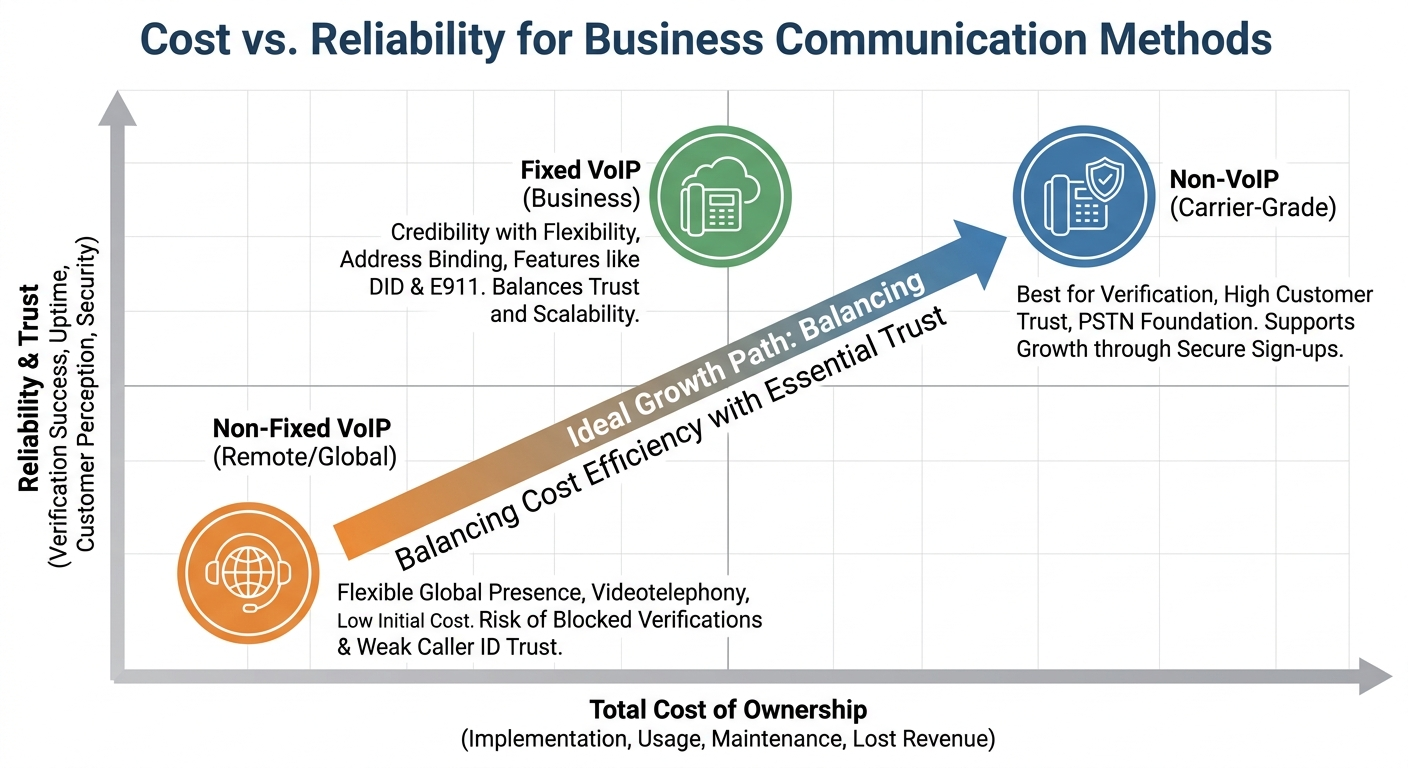
Fixed VoIP ties a telephone number to a verified physical address, which anchors it to the Public Switched Telephone Network.
Non-fixed VoIP issues a telephone number with no address requirement, which lets anyone generate one in seconds.
Fixed VoIP supports Enhanced 911 with automated location data, a Federal Communications Commission obligation for interconnected providers.
Non-fixed VoIP often lacks reliable emergency routing, which weakens its trust signal.
Fixed VoIP earns predictable treatment because the Public Switched Telephone Network underlies its number registration. Caller ID on a fixed VoIP line usually matches a real business identity. A non-fixed VoIP number carries far weaker identity signals, which pushes platforms to reject it.
What is a non-VoIP number? (the traditional telecom side)
A non-VoIP number is a telephone number issued inside regulated carrier infrastructure, not an outdated technology. The Public Switched Telephone Network (PSTN), a circuit-switched system built for high reliability, underlies every traditional phone number. This foundation gives non-VoIP numbers the trust that verification systems reward.
A landline is a type of telephone number that uses the PSTN over a wired connection. Telephony, the field of transmitting voice across distance, encompasses both the PSTN and modern VoIP. A telephone connects to the Public Switched Telephone Network to reach any other subscriber.
One split matters for verification. A landline delivers voice reliably but cannot receive SMS verification codes. Mobile non-VoIP numbers, issued by a cellular carrier, receive one-time codes and pass platform checks. Choose a mobile non-VoIP number, not a wired landline, when SMS verification is the goal.
How non-VoIP numbers are registered and why it matters for verification
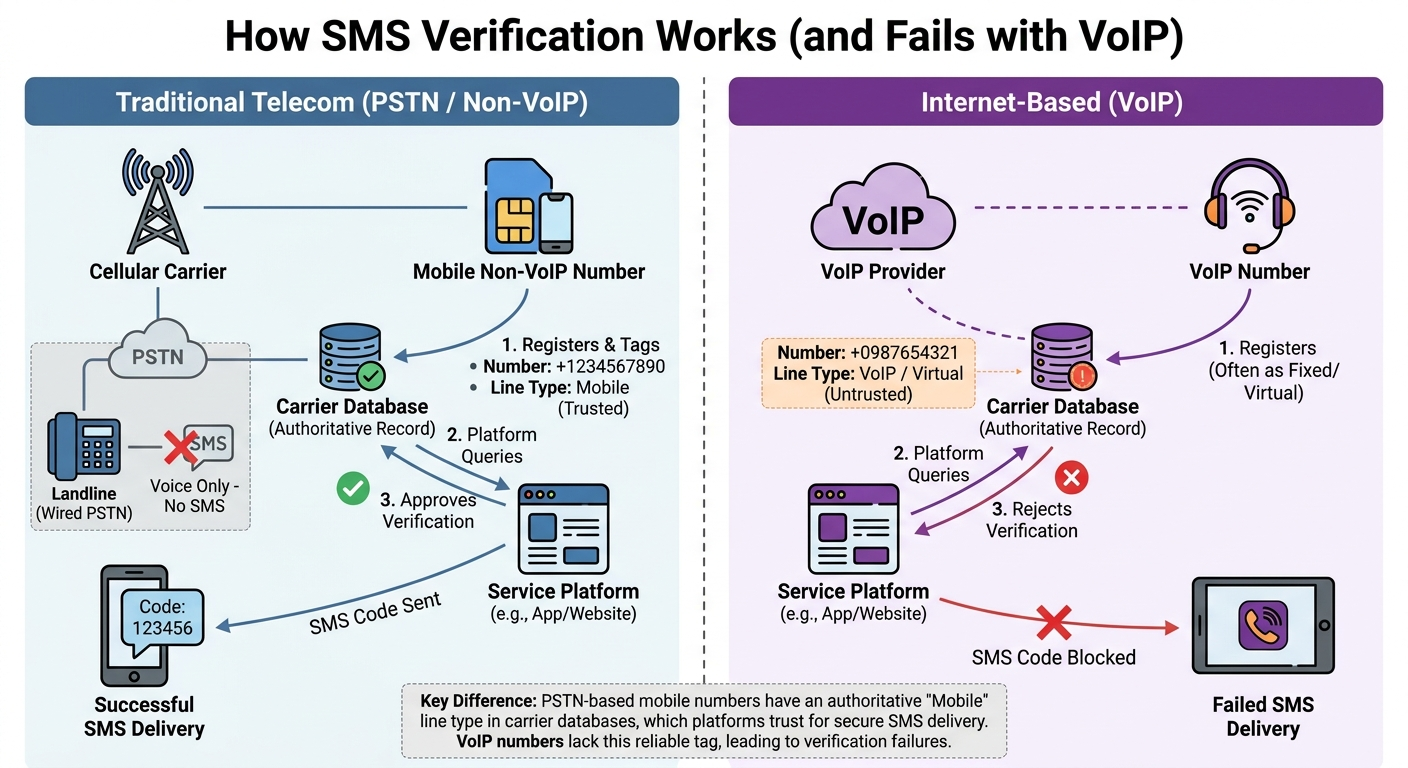
Carrier registration creates a trust signal that platforms read in real time. When a cellular carrier issues a telephone number, it records a line type in an industry database. SMS verification connects to that telephone number through this line-type classification.
The registration chain runs in three steps:
A carrier registers the telephone number and tags its line type as mobile.
A platform queries the carrier database during sign-up.
The platform reads a mobile line type and approves the verification.
The Public Switched Telephone Network supports this SMS verification path because its records are authoritative. Using a non-VoIP number for verification is a legitimate platform requirement, not a workaround.
VoIP vs non-VoIP numbers: core differences at a glance
VoIP numbers win on cost and flexibility, while non-VoIP numbers win on platform trust and SMS verification success. A VoIP phone utilizes the Internet Protocol, which lowers cost but weakens its identity signal. The Public Switched Telephone Network underlies traditional phone numbers, which raises trust for a non-VoIP telephone number.
The table below sets both types side by side across the attributes that decide real outcomes.
Attribute
VoIP number
Non-VoIP number
Connection type
Internet Protocol network
Public Switched Telephone Network
Cost structure
Often free or very low
Small per-number or rental fee
Reliability
Depends on internet quality
High, carrier-grade
SMS verification compatibility
Variable, often rejected
Consistent, widely accepted
Caller ID trust
Weak on non-fixed VoIP
Strong, carrier-verified
Best use case
Short-term, low-stakes tasks
Accounts you cannot lose
A telephone number is verified by SMS verification only when its line type reads as carrier-issued. Caller ID is a feature of a telephone number that displays the caller to the recipient. The synthesis is direct: non-VoIP wins for trust and stable delivery, VoIP wins for speed and flexibility on disposable tasks.
Privacy comparison, a counterintuitive finding
VoIP numbers are not automatically more private than non-VoIP numbers. Google Voice, an example of a VoIP phone, requires a full Google account tied to personal data. TextNow offers a VoIP phone but links it to an app profile and device identifiers.
A telephone number can be a VoIP phone or a carrier line. Privacy depends on the provider, not the technology. The assumption that VoIP equals anonymity does not hold. Privacy comes from how little data a specific provider collects, not from whether the number runs over the Internet Protocol.
Verification code delivery speed, why consistency matters more than raw speed
Non-VoIP numbers deliver verification codes more consistently than VoIP numbers, even when peak speed looks similar. A VoIP phone can receive a code fast on one platform and fail on the next. SMS verification is problematic with VoIP because detection happens before delivery.
The Public Switched Telephone Network supports SMS verification with predictable routing, so a non-VoIP telephone number rarely stalls. A telephone number is verified by SMS verification within seconds when the line type clears. Waiting on a code that never arrives carries a hidden cost. A stalled sign-up wastes time and risks a locked account.
Why platforms block VoIP numbers: the detection wall explained
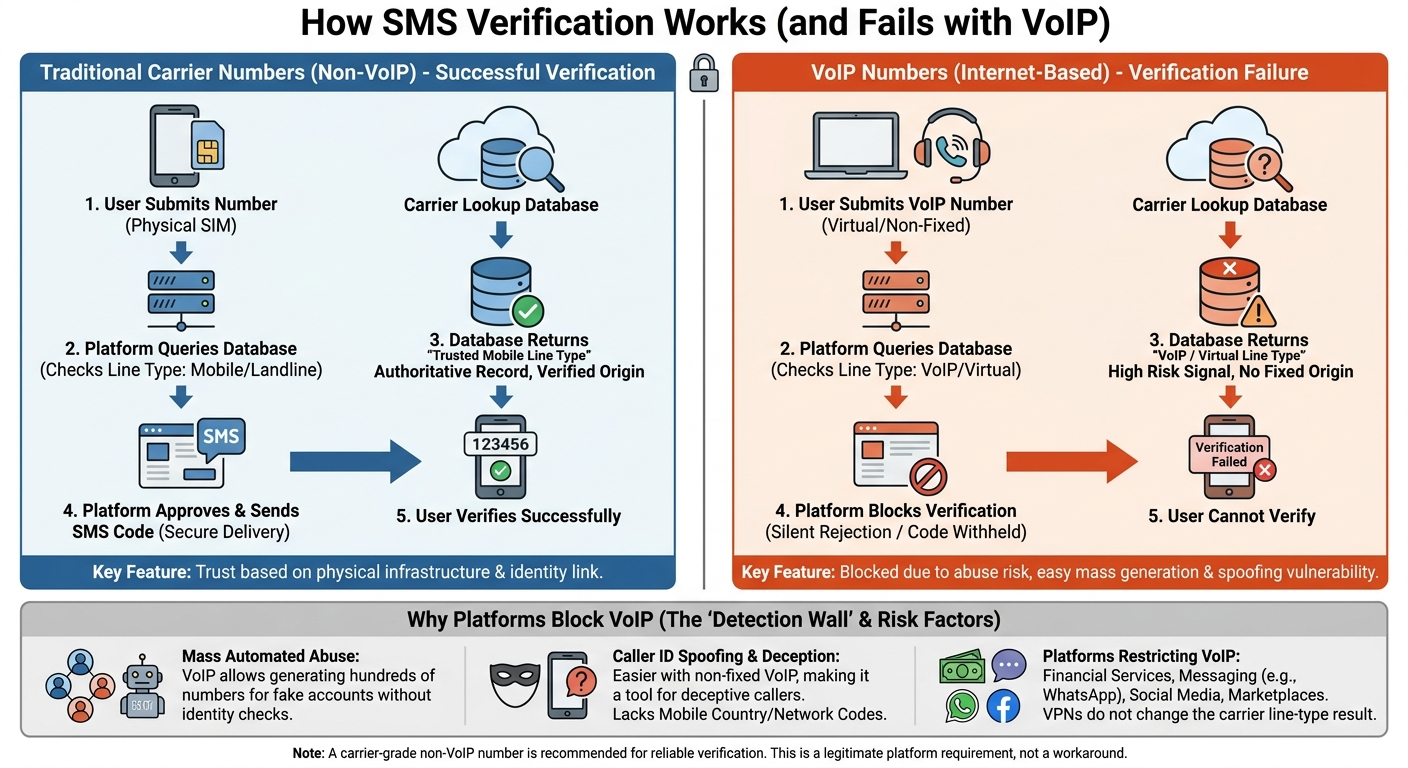
Platforms block VoIP numbers because mass automated account creation and abuse flow disproportionately through them. A VoIP phone lets one actor generate hundreds of numbers with no physical SIM and no identity check. SMS verification is problematic with VoIP for this exact reason, so platforms treat VoIP as a risk signal.
Detection often produces a silent rejection. A platform may accept the number, then withhold the code without explaining why. This quiet failure frustrates legitimate users who never learn that a VoIP phone caused the block.
Caller ID spoofing is easier with VoIP, which deepens the distrust. Spoofing works on VoIP systems because non-fixed numbers carry no verified origin. This vulnerability makes non-fixed VoIP a favored tool for deceptive callers.
How carrier lookup databases flag VoIP numbers
Carrier lookup databases store a line-type classification that platforms query through an API in real time. Every telephone number carries a tag, mobile, landline, or VoIP, inside these carrier records. The Public Switched Telephone Network underlies traditional phone numbers, so a carrier line reads as trusted.
The lookup mechanism runs in four steps:
A user submits a telephone number during sign-up.
The platform sends a lookup query to a carrier database.
The database returns the line type.
The platform approves a carrier line or blocks a VoIP phone.
Two myths die here. A VPN does not change the result, because blocking works at the carrier layer, not the network layer. An older VoIP number does not pass, because the line-type tag never changes. VoIP numbers also lack the Mobile Country Code and Mobile Network Code that cellular numbers carry (miniOrange, 2026).
Why bad actors prefer non-fixed VoIP, and why that hurts legitimate users
Non-fixed VoIP became an abuse tool because mass number generation pairs with easy Caller ID spoofing. Caller ID spoofing is easier with VoIP, and it is a risk of any non-fixed line. This tactic attempts to deceive the recipient by disguising the true origin.
This abuse creates unfair collateral damage. A legitimate user with a non-fixed VoIP number inherits a reputation built by bad actors.
The Federal Communications Commission prohibits Caller ID spoofing intended to deceive, harm, or wrongfully obtain value. Penalties reach $10,000 per violation. Honest users still pay the trust penalty, which is why a carrier-grade non-VoIP number remains the safer choice.
Which major platforms block or restrict VoIP numbers
Major platforms across four categories restrict VoIP numbers during SMS verification. A telephone number is verified by SMS verification, so the block hits at the entry point for each service.
VoIP restrictions concentrate in these categories:
Messaging platforms: WhatsApp does not support VoIP numbers for registration.
Financial services: banks and payment apps apply strict line-type screening at sign-up.
Social media: Instagram and similar networks can reject VoIP numbers at verification.
Freelance and marketplace platforms: identity-sensitive services block VoIP to reduce duplicate accounts.
Financial platforms and WhatsApp rank among the strictest blockers as of 2026. Google Voice numbers can also fail SMS verification on services that enforce line-type checks. A non-VoIP number clears all four categories because its telephone number reads as carrier-issued.
The hidden costs of "free" VoIP numbers
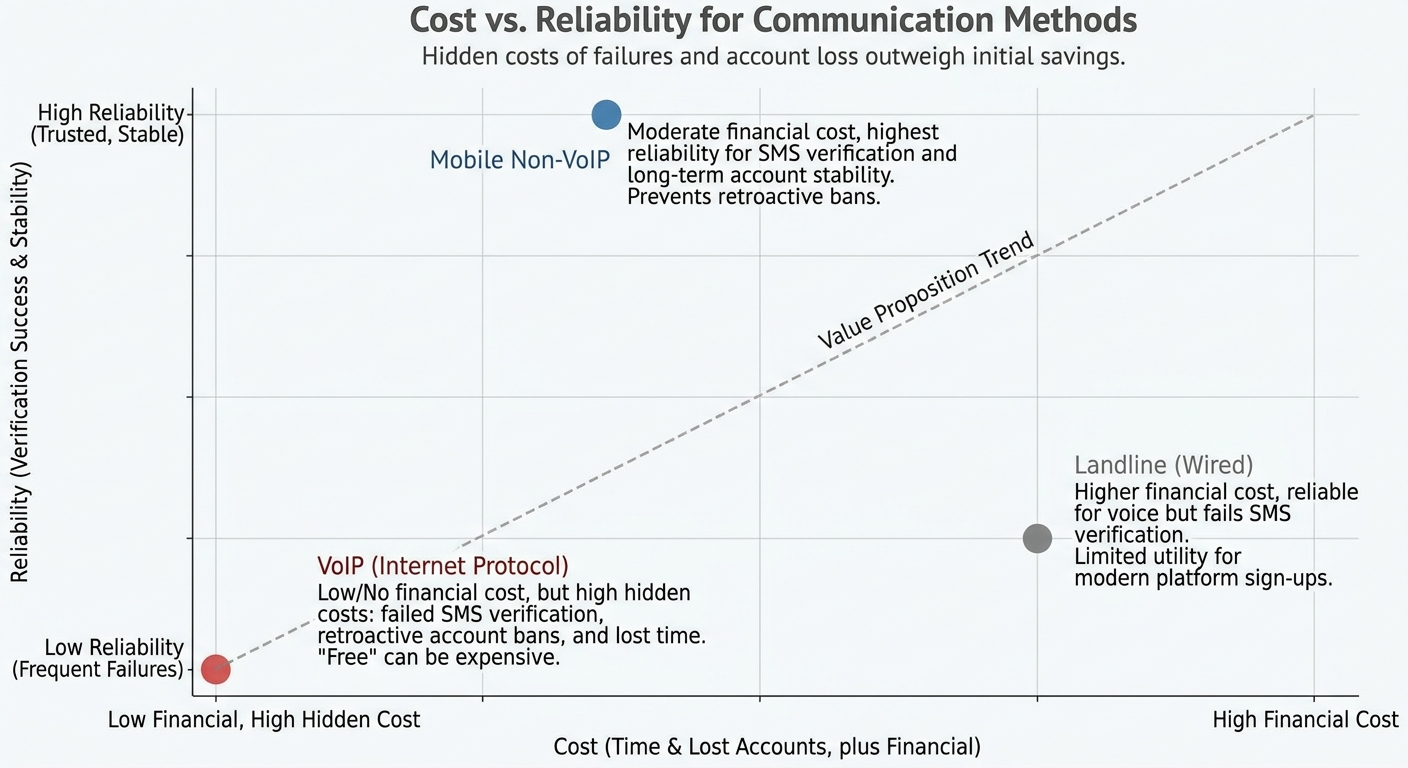
The word free in front of a VoIP number hides its most expensive risk. A VoIP phone utilizes the Internet Protocol at little or no cash cost. The real price shows up as lost time and lost accounts. Voice over Internet Protocol can offer cost savings, but only when failure carries no consequence.
Three hidden costs stack up. SMS verification is problematic with VoIP, so codes stall and sign-ups fail. A platform can retroactively ban an account verified with a VoIP number. Google Voice numbers can face SMS verification issues that surface only after months of use.
The comparison is stark. A small fee for a carrier-grade non-VoIP number is trivial next to the loss of a valued account.
Real-world scenario, the six-month account loss
Retroactive VoIP bans destroy accounts that took months to build. Picture a marketer who verifies a business profile with a non-fixed VoIP number. The profile grows for half a year. A routine security review flags the VoIP line type, and the platform suspends the account.
SMS verification is problematic with VoIP even after the account looks established. A telephone number is verified by SMS verification at sign-up, but line-type checks can rerun later. Paying a small fee for a carrier-grade non-VoIP number would have protected six months of work. The cost gap between prevention and loss is not close.
When to use a VoIP number: legitimate use cases
VoIP numbers fit any task where a failed verification carries no lasting cost. A VoIP phone is not a flawed tool, only the wrong tool for high-stakes accounts. Voice over Internet Protocol enables cheap, flexible numbers that suit disposable sign-ups.
Good VoIP scenarios share low stakes. Google Voice, an example of a VoIP phone, works for a free-trial account you may never reopen. TextNow offers a VoIP phone that suits software testing during development. A VoIP phone is often used by businesses for internal call routing where verification is not involved.
The rule is simple. If losing the account costs nothing and it holds no long-term value, VoIP fits.
When to use a non-VoIP number for verification and beyond
Use a non-VoIP number whenever losing the account would cause financial, professional, or personal harm. The Public Switched Telephone Network underlies traditional phone numbers, so a non-VoIP telephone number clears strict checks. This makes it the default for anything you cannot afford to lose.
Non-VoIP is mandatory in these cases:
Business accounts on platforms that rerun line-type checks after sign-up.
Financial accounts where banks enforce the tightest verification rules.
Valuable social profiles built over months of audience growth.
Long-term account management where a single ban erases sustained work.
A landline is known for high reliability, but a mobile non-VoIP number adds SMS verification on top. The Public Switched Telephone Network supports SMS verification through carrier records. Legitimate SMS verification services use real carrier infrastructure.
SMSFAST is one example of a virtual number service built for SMS verification. It offers short-term activation numbers and long-term rentals. An instant automated refund applies if no code arrives.
How to choose a non-VoIP provider
Choose a non-VoIP provider by testing for real carrier infrastructure above every other factor. The Public Switched Telephone Network supports SMS verification, so a provider that issues carrier-grade telephone numbers clears platform checks. A telephone number is verified by SMS verification only when its line type reads as carrier-issued.
Judge each provider against clear criteria:
Real carrier infrastructure that produces genuine mobile line types.
Fast, consistent code delivery rather than headline peak speed.
Transparent pricing with no hidden per-code charges.
Minimal personal data collected at sign-up.
A verified track record of successful verifications.
SMSFAST positions itself around these criteria. It pairs virtual numbers for SMS verification with an instant automated refund when a code fails. Test any provider on a low-stakes account first, then commit once the delivery record holds.
VoIP vs non-VoIP for business: which one supports growth?
Businesses rarely face a binary choice, since fixed VoIP and non-VoIP each serve a distinct job. A VoIP phone utilizes the Internet Protocol for internal calling. Non-VoIP telephone numbers handle verification and customer trust. Voice over Internet Protocol enables scalable internal communication, and Telephony encompasses both models under one roof.
The revenue logic is direct. A blocked verification stalls a customer sign-up and costs a sale. Spoof-prone Caller ID erodes trust on outbound sales calls.
RingCentral provides a VoIP phone with business features and offers communication solutions such as Direct Inward Dialing. Direct Inward Dialing is a feature of business VoIP systems that routes incoming calls to the right person. Voicemail is often integrated with a VoIP phone, which keeps message handling in one place.
Fixed VoIP for business: credibility with flexibility
Fixed VoIP suits an established business that wants IP flexibility with carrier-grade credibility. A VoIP phone can be a fixed VoIP line bound to a physical address. That binding changes its status in carrier databases.
The Public Switched Telephone Network underlies traditional phone numbers. Address binding brings a fixed VoIP line closer to that trust tier.
Fixed VoIP delivers concrete business features. Direct Inward Dialing routes each incoming call to a specific extension without a switchboard. Voicemail is often integrated with a VoIP phone for unified messaging.
A telephone number on a fixed VoIP line can also meet Enhanced 911 obligations. The Federal Communications Commission requires this from interconnected VoIP providers. Emergency service compatibility is a decisive factor for any office phone system.
Non-fixed VoIP for remote and global teams
Non-fixed VoIP suits distributed teams that need local presence across many markets without physical offices. A VoIP phone can be a non-fixed VoIP line. Voice over Internet Protocol enables it on any internet connection. This lets a company show a local number in several countries at once.
Non-fixed VoIP carries real perks and one caution. Videotelephony is a feature of a VoIP phone that supports face-to-face team calls. Voicemail is often integrated with a VoIP phone for remote message access.
Caller ID is a feature of a telephone number. A non-fixed line risks a weak trust signal in B2B sales. Weigh that reputation risk before using non-fixed VoIP for outbound client outreach.
Common myths about VoIP numbers debunked
Five myths about VoIP numbers deserve a direct correction. Each myth fails against how carrier detection actually works.
Myth: A VPN hides a VoIP number from detection. Reality: The Public Switched Telephone Network operates at the carrier layer, so a VPN changes nothing. SMS verification still fails.
Myth: An older VoIP number passes as trusted. Reality: A VoIP phone utilizes the Internet Protocol and keeps its line-type tag forever. SMS verification still rejects it.
Myth: All VoIP is more anonymous. Reality: Voice over Internet Protocol relies on the Internet Protocol, yet Google Voice and TextNow both collect account data. Anonymity depends on the provider.
Myth: Using a non-VoIP number for verification breaks the rules. Reality: A telephone number is verified by SMS verification as a normal, permitted step.
Myth: Caller ID proves a VoIP caller is genuine. Reality: Caller ID spoofing is easier with VoIP, so the display can mislead.
How to choose the right number type for your needs
Choose your number type by answering three questions about the account. A VoIP phone can be a fixed VoIP or a non-fixed VoIP line. Telephone numbers pass SMS verification only when the line type clears. Telephony encompasses both VoIP and the Public Switched Telephone Network, so the right pick depends on stakes.
Work through the decision in order:
Question 1: Does losing this account cause harm? If yes, choose non-VoIP.
Question 2: Will the platform rerun line-type checks later? If likely, choose non-VoIP.
Question 3: Is this a throwaway sign-up with no value? If yes, VoIP fits.
Telephony involves a telephone number in every case. The Public Switched Telephone Network supports SMS verification for the strict ones. When in doubt, choose non-VoIP, since the marginal cost is tiny next to the risk of a wrong call.
Get your virtual number today
SMSFAST delivers virtual numbers in many countries instantly, with no SIM card needed. See current pricing
Frequently Asked Questions
Can a VoIP number receive SMS verification codes?
A VoIP number can receive some SMS verification codes but fails on strict platforms. SMS verification is problematic with VoIP because carrier lookups flag the line type. WhatsApp, banks, and social platforms reject VoIP numbers, while non-VoIP numbers stay consistent.
What is the difference between fixed VoIP and non-fixed VoIP?
Fixed VoIP binds a telephone number to a physical address, while non-fixed VoIP has no address requirement. The bound line earns more trust because address binding ties it toward the PSTN. Non-fixed VoIP is easier to generate in bulk, so platforms block it more often.
Why do platforms block VoIP numbers?
Platforms block VoIP numbers because mass automated account creation flows through them. A VoIP phone lets one actor generate hundreds of numbers with no SIM or identity check. Carrier lookup databases flag the VoIP line type in real time, and Caller ID spoofing is easier with VoIP.
Is it legal to use a non-VoIP number for platform verification?
Using a non-VoIP number for platform verification is legal and expected. A telephone number is verified by SMS verification as a standard sign-up step. Platforms request a carrier-issued number because the PSTN makes it reliable, a normal requirement rather than a rule violation.
Are non-VoIP numbers safer than VoIP numbers for account security?
Non-VoIP numbers are generally safer for account security than VoIP numbers. A carrier-issued telephone number resists the retroactive bans that hit VoIP accounts. SMS verification is problematic with VoIP, which raises suspension risk and makes non-VoIP the more stable foundation.
What should be done if a verification code is not arriving?
When a verification code is not arriving, first confirm the number is a carrier-grade non-VoIP line. SMS verification is problematic with VoIP, so a VoIP phone is the common cause. Wait 60 seconds, request the code again, then switch to a non-VoIP number if it still stalls.
Can the same non-VoIP number be used for multiple platforms?
The same non-VoIP number can often verify multiple platforms, with limits. A telephone number is verified by SMS verification on each service separately. WhatsApp ties one active registration to one number, so a long-term non-VoIP rental reserves one number for reuse.
Renting usually beats buying a virtual number. See real 2026 pricing, number portability rules, and which option fits freelancers, startups, and call centers.