Creating a Gmail account without a phone number is possible in 2026. Google's own account setup marks the phone step as optional. The Skip option appears for privacy-minded users, people managing several inboxes, and anyone without a number on hand. Google decides case by case, so Skip shows in some sessions and hides in others.
The methods below cover Android, iOS and desktop. Each section also handles the case where Skip disappears.
Does Gmail actually require a phone number?
Gmail does not set a phone number as a universal requirement. Google's official help page lists the phone step as optional (Google Account Help, 2026). A Gmail account is one service inside a Google Account, and its creation flow shows the phone prompt.
Google's system scores each sign-up by risk before it decides whether to show the Skip button. Phone number verification is triggered more often by a low-reputation IP address. A device with prior account history or several new accounts in a short window also raises the odds. Spam prevention drives this logic: Google stops automated bulk registrations, not real users.
Registration through a mobile device's settings shows the Skip option more often than a desktop browser does. Sharing a personal number widens data exposure, so some users prefer a virtual or disposable number instead.
Why Google asks for a phone number and why skipping is still possible
Google asks for a phone number for three reasons, and none of them requires your personal number. Spam prevention, account recovery, and two-factor authentication each have an alternative that works without a SIM card. Two-factor authentication is a login step that confirms identity with a second code beyond the password.
Google requests a number for these purposes, each with a phone-free alternative:
Spam prevention: a recovery email can serve the same anti-abuse purpose.
Account recovery: a recovery email restores access without a phone number.
Two-factor authentication: an authenticator app replaces SMS codes entirely.
Each alternative keeps your Google Account protected while leaving your personal number out of your profile. The next sections show how to set up the account first, then how to secure it.
How to create a Gmail account without a phone number: step-by-step methods
Three device methods let you create a Gmail account without a phone number, and each suits a different setup. Prepare a recovery email on another provider before you start, since Google asks for one during setup. The order below runs from the most reliable method to the least stable one, so start at the top.
How to create Gmail without a phone number on Android
Registration through the Android Settings app, rather than a browser, gives you the best chance of seeing the Skip option. Follow these steps on the Android device:
Open the Settings app on the Android device.
Scroll to Passwords & accounts, then tap it.
Tap Add account near the bottom of the screen.
Choose Google from the account-type list.
Wait for the Google sign-in screen to load fully.
Tap Create account, then select For my personal use.
Enter your first and last name, then tap Next.
Set your birthday and gender, then tap Next.
Pick a suggested Gmail address or create your own.
Enter a strong password, then tap Next.
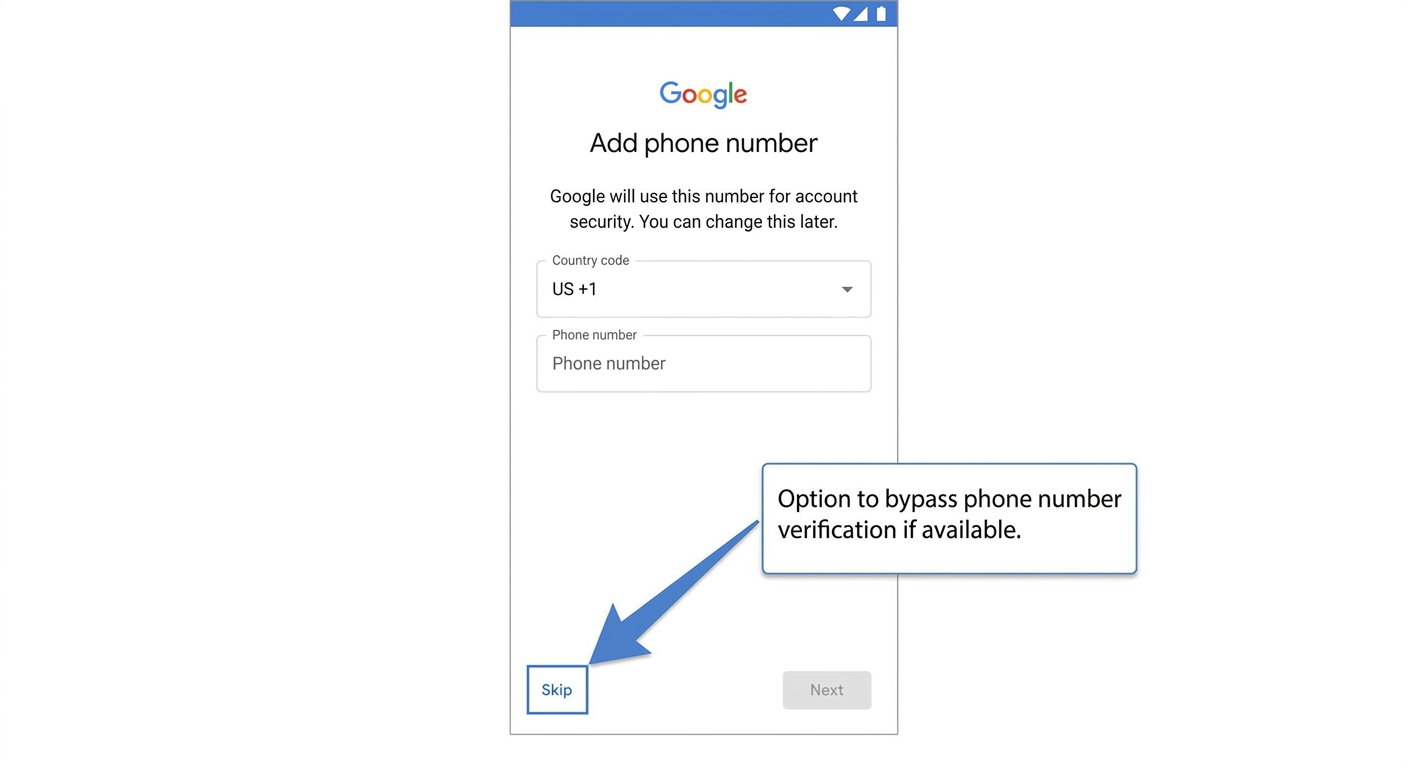
On the phone number screen, tap Skip if it appears.
Accept Google's terms to finish creating the account.
Note for older Android versions: the menu is labeled Sync Accounts instead of Passwords & accounts.
How to create Gmail without a phone number on iPhone and iPad
The iOS path differs from Android, yet the strategy stays the same: use the device settings, not a browser. Follow these steps on the iPhone or iPad:
Open the Settings app on the iPhone or iPad.
Scroll down and tap Mail.
Tap Accounts, then tap Add Account.
Select Google from the provider list.
Tap Continue if iOS asks to use google.com to sign in.
On the Google screen, tap Create account.
Choose For my personal use from the menu.
Enter your name, birthday, and gender across the prompts.
Select a Gmail address or type a custom one.
Create a strong password, then tap Next.
When the phone number screen loads, tap Skip if shown.
Agree to the terms to complete Gmail account setup.
Note for older iOS versions: the menu may read Passwords & Accounts. Tip: if Create account never appears, the device is already signed in to a Google Account.
How to create a new Gmail account without a phone number on desktop
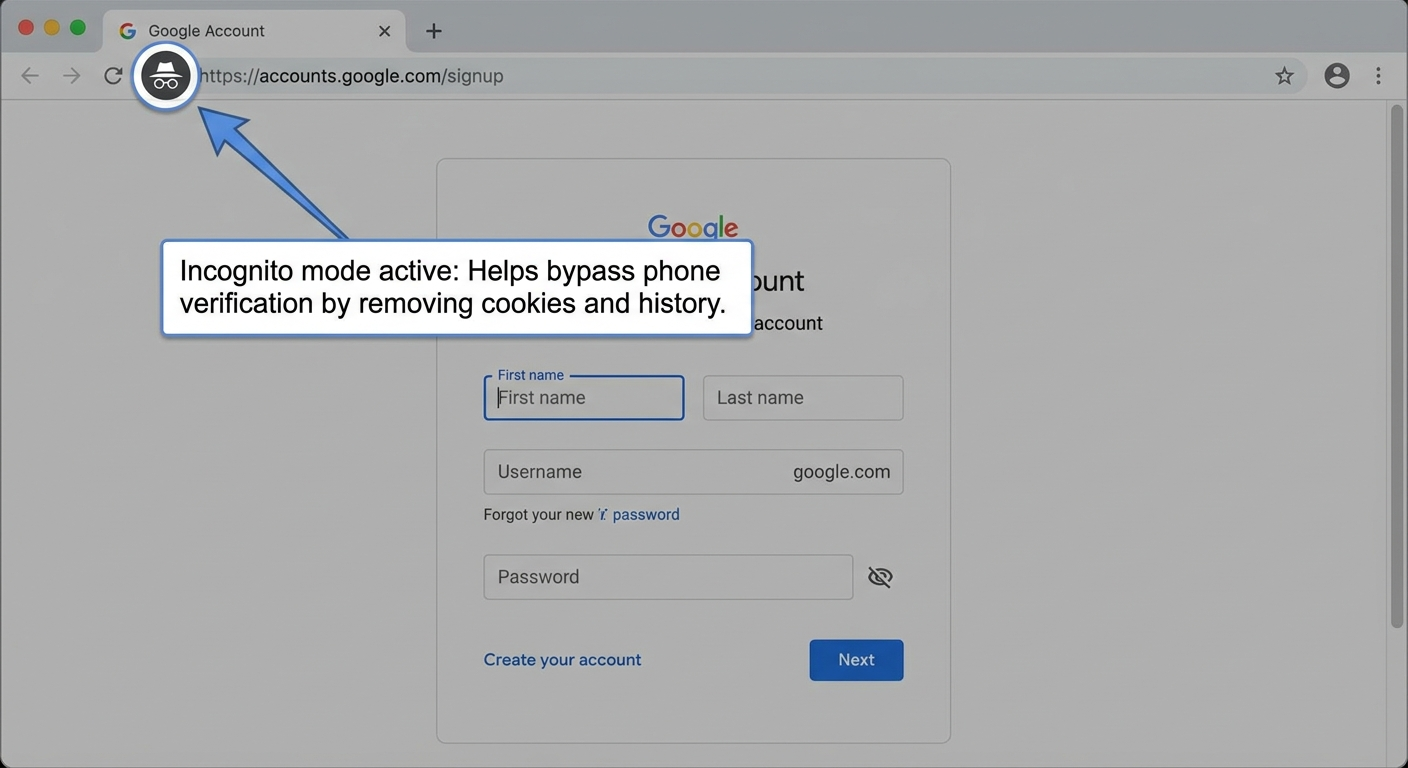
The desktop method is the best known route, yet it stays the least stable, so treat it as a backup. Incognito mode removes three signals that raise Google's risk score. Those signals are cookies from earlier sessions, browser history, and data from existing Google accounts. Follow these steps in a browser:
Open your browser and start a new incognito or private window.
Go to accounts.google.com/signup in that window.
Click Create account, then choose For my personal use.
Enter your first and last name, then click Next.
Add your birthday and gender, then click Next.
Select a suggested Gmail address or create your own.
Enter and confirm a strong password, then click Next.
On the phone number step, click Skip if the link shows.
Review and accept Google's privacy and terms notice.
Finish setup to open your new Gmail inbox.
Tip: if Skip does not show, close the window, wait 30 minutes, then repeat the steps.
Try the Gmail app on a mobile device as an alternative mobile method
The Gmail app runs a different sign-up process and often asks for a phone number less frequently. Follow these steps when the Settings app method stalls:
Install the Gmail app from Google Play or the App Store.
Open the Gmail app and tap the sign-in prompt.
Tap Add another account on the account screen.
Choose Google as the account type.
Tap Create account, then select For my personal use.
Enter your name, birthday, and gender in order.
Choose a Gmail address or create a custom one.
Set a strong password, then tap Next.
On the phone number screen, tap Skip if available.
Accept the terms to activate the new Gmail account.
Note for iPhone: if Create account is missing in some iOS versions, use Settings then Mail instead.
What to do if the Skip button does not appear
Google's verification behavior stays unpredictable, so a missing Skip button does not mean you did anything wrong. Phone number verification sometimes stays mandatory on a given attempt, even when every step was followed.
Four sub-strategies can change the risk signals that Google reads. They include signing up through another Google service, the no-number option, a private window, or a network change. Each one is worth a try before you turn to a virtual number.
Try signing up through a different Google service such as YouTube, Drive, or Docs
Starting account creation from YouTube, Google Drive, or Google Docs sometimes meets a softer verification threshold. Google's verification logic is not identical across every service. YouTube in particular tends to show the Skip option during a fresh sign-up. The account you create this way is a full Google Account with Gmail.
YouTube often shows the Skip option during a fresh account sign-up.
Google Drive starts the same standard Google account creation flow.
Google Docs opens account creation from its document sign-in screen.
Follow these steps: open one of the three services, click Sign in, then Create account. Select For my personal use, enter your details, and choose a Gmail address with a strong password. On the phone number screen, click Skip if it appears.
Use the no phone number option during sign-up
Some Google sign-up screens show a link below the number field. The link states that you do not have a phone number. Selecting that link can open an alternative verification path that sometimes ends with the Skip option.
The option does not appear on every attempt, and it does not always let you skip. Treat it as one more thing to try before paid numbers.
Look for the link directly under the phone entry field on the verification screen. Google may then ask you to confirm identity another way before it decides whether to show Skip. This route is worth attempting, though Google does not promise it will remove the number requirement.
Use incognito or private browsing mode
Incognito mode helps because it strips three signals that raise Google's risk score during a Gmail sign-up. Cookies from previous sessions, saved browser history, and data from existing Google accounts all push the score higher. Removing them lowers the odds that phone number verification becomes mandatory.
Clear your cookies before you open the incognito window for the cleanest result. Avoid signing in to any other Google account in that session, and try a different browser or Wi-Fi network. Device and IP signals still persist in incognito mode, so pair it with a network change for the best odds.
Switch networks or use a VPN
Your IP address is one of the main signals Google reads when it scores a sign-up for risk. Google assigns risk ratings to IP addresses, and shared ranges in offices or cafes can trigger stricter verification. Changing your network changes that signal, which can bring back the Skip option.
Try three network switches for a fresh signal. Move from home Wi-Fi to mobile data, use a friend's connection, or toggle airplane mode.
A VPN, which is a Virtual Private Network that reroutes your traffic through another server, can also change the IP. Google recognizes data-center IP addresses used by many free VPNs, so residential IPs work better. A VPN can also prompt extra checks by itself.
Alternative ways to create Gmail without a phone number when verification is required
Three alternatives cover the case where Google keeps phone number verification mandatory. They are virtual numbers, prepaid SIM cards, and free online SMS sites. Each differs in reliability, privacy, and cost, and each is a fallback rather than a shortcut. The table compares all three so you can match the method to the account.
Method
Reliability
Privacy level
Cost
Best for
Virtual number (SMSFAST)
Moderate
Higher than a personal number
From $0.24 per activation
One or several Google accounts
Prepaid SIM card
High
Moderate
Price of a local SIM
Users managing two to three or more accounts
Free online SMS site
Low
Very low, codes are public
$0
Not advised for accounts that matter
A virtual phone number is a number that receives SMS over the internet rather than through a physical SIM card. SMSFAST provides paid, exclusive numbers that are not part of public pools. Privacy stays higher than posting to a shared public site.
You can get a virtual number for Google on SMSFAST from $0.24 per activation. SMSFAST refunds your balance instantly if no code arrives.
Prepaid SIM cards offer high reliability and moderate privacy. They suit anyone opening two to three or more Google accounts.
Free online SMS sites often run on VoIP (Voice over Internet Protocol) pools. They cost nothing and post every code in public, so Google frequently rejects them. Read more on how a virtual phone number works before choosing between these options.
Can a Gmail account be recovered without a phone number?
A Gmail account can be recovered without a phone number, and Google Prompt is the main alternative recovery mechanism. Google Prompt sends a sign-in confirmation to an Android device already signed in to the account. A recovery email is the second key path back into a locked account.
Set up Google Prompt in six steps:
Open myaccount.google.com and sign in to the Google Account.
Select Security from the left menu.
Find the section for how you sign in to Google.
Choose Google Prompt, then follow the setup instructions.
Confirm the trusted Android device that will receive prompts.
Test the prompt by signing in from another browser.
Without a recovery email and without a signed-in device, Google support will not restore the account manually in most cases.
How to secure a Gmail account created without a phone number
Creating a Gmail account without a phone number is fully possible. The setup asks for a more deliberate approach to security. A phone number often doubles as a recovery and login backup. Without a number, the account needs two replacements in place.
A recovery email and an authenticator app both take under five minutes to set up.
Account recovery options are the safety net that keeps long-term access to a Gmail account. Skipping the phone number is fine as long as you add these two protections right after setup. The subsections below cover each one in order.
Set up a recovery email address
A recovery email is the primary way to confirm your identity if you ever lose access to the account. Without a phone number and without a recovery email, restoring a locked Gmail account becomes nearly impossible. Use an address on a different provider, such as Outlook or Yahoo, rather than another Gmail account.
Add a recovery email in six steps:
Open myaccount.google.com and select Security.
Scroll to the recovery email option, then select it.
Enter an address on a different provider, such as Outlook.
Send the verification code to that recovery address.
Enter the code Google emails to that address.
Save the change to confirm the recovery email.
Enable two-factor authentication without SMS
Two-factor authentication through an authenticator app protects the account without any SMS code. An authenticator app generates codes locally on your device, so it stays immune to SIM-swapping attacks. Google Authenticator, Authy, and Microsoft Authenticator all work, and Authy adds cloud backups of your codes.
Set up app-based two-factor authentication in nine steps:
Install Google Authenticator, Authy, or Microsoft Authenticator.
Select Authenticator app as the second step (setup guide).
Open your authenticator app and tap Add.
Scan the QR code Google displays on screen.
Enter the six-digit one-time code your app generates.
Confirm the code to link the authenticator app.
Save the backup codes Google offers in a safe place.
Google Prompt is a good alternative for anyone with a trusted Android device already linked.
Additional account security best practices
A short checklist covers the remaining habits that keep a phone-free Gmail account safe. Run through these five practices after setup:
Set a unique 12-character password stored in a manager such as Bitwarden or 1Password.
Turn on Google security alerts to catch sign-ins from new devices.
Review recent account activity at myaccount.google.com every few weeks.
Avoid signing in on public Wi-Fi without a trusted VPN connection.
Check that the recovery email still works, since users skip this last step most often.
The bottom line on creating Gmail without a phone number
Creating a Gmail account without a phone number is a supported path, not a workaround against Google. The phone step is optional in Google's own flow.
Device settings give the highest chance of seeing Skip. A recovery email plus an authenticator app keep the account safe afterward.
Privacy motivates this choice for many users. In 2025, 183 million email records surfaced in the Synthient dataset (Have I Been Pwned, 2025). That event did not come from Google's own servers. SMSFAST lists current per-number pricing on its prices page if you reach the point where verification stays mandatory.
Get your virtual number today
SMSFAST delivers virtual numbers in many countries instantly, with no SIM card needed
Frequently Asked Questions
Can a Gmail account be made without a phone number?
Yes, a Gmail account can be created without a phone number, since Google marks the phone step as optional. The device settings method on Android or iOS shows the Skip option most reliably. If Skip stays hidden, switching networks or using incognito mode often restores it.
Why does Google keep asking for a phone number even when trying to skip it?
Google scores each sign-up by risk before it shows or hides the Skip button. A shared IP address, prior device history, or several new accounts in a short window all raise that score. When the score is high enough, phone number verification stays mandatory on that attempt.
Can a Gmail account created without a phone number still be kept secure?
Yes, a Gmail account without a phone number stays secure once you add a recovery email and an authenticator app. A recovery email restores access after a lockout, and an authenticator app generates login codes locally. Both take under five minutes and replace what a phone number would cover.
Are virtual phone numbers safe to use for Gmail verification?
Paid virtual numbers from a service like SMSFAST are safer than free public numbers, since only you see the SMS. Free online numbers post every code publicly and are frequently rejected by Google. Paid numbers succeed in most cases, though delivery varies by country and is never promised.
Are there any drawbacks to creating Gmail without a phone number?
Two drawbacks stand out for a Gmail account without a phone number. Recovery is harder after a lockout, because Google leans on a phone number to confirm identity. Security setup also needs more care, since a recovery email and an authenticator app must replace the missing number.
In this guide, you’ll learn how to create and verify your Twitter account without using a real phone, including safe ways to unlock or confirm existing accounts.