An SMS code is a short numeric one-time password that a platform texts to your phone to confirm your identity or approve an action. Most codes run 4 to 6 digits and expire automatically, usually within minutes. Convenient as they are, SMS codes also carry real security risks, and stronger options exist.
What is an SMS code? Breaking down the basics
You open your crypto exchange, type your password, and the screen asks for a code. Seconds later a text arrives with six digits. That short number is an SMS code: a one-time password sent by text message to verify your identity or authorize an action. Banks, exchanges, and wallets lean on this small string to confirm that the person logging in holds the registered phone.
An SMS code pairs tightly with the idea of a one-time password (OTP), a single-use code that stops working after one login or a short window. The mobile network carries the code to your handset, and two-factor authentication puts that code to work. Each gets its own section below.
Key takeaways
An SMS code is a numeric one-time password, usually 4 to 6 digits, sent by text to verify identity.
The code expires fast, often within minutes, though the window depends on the platform.
SMS reaches almost any phone, yet ranks as the weakest common second factor, open to SIM swap.
Authenticator apps and hardware keys guard high-value accounts more strongly.
SMS code meaning and other common names
Platforms label the same mechanism in different ways. A bank might say "verification code" while an exchange says "one-time passcode," yet both point to one numeric string you type once. These names overlap rather than divide cleanly:
Verification code: a common label on banking and crypto login screens.
Passcode or one-time passcode: stresses that the code works only once.
Confirmation code: often used when you approve a transaction or a sign-up.
SMS OTP: the technical shorthand for a one-time password sent by text.
What is a verification code? How it relates to an SMS code
A verification code is the broad category: any single-use code that confirms you own an account. An SMS code is one delivery route for that category, the version that lands as a text on your phone. Picture "verification code" as the type of key and "SMS code" as the way the key reaches you.
The same code can travel other routes. Email drops it into your inbox, and an authenticator app builds it on your device with no text at all.
How SMS verification works behind the scenes
Follow the path a code travels, and you spot where someone could intercept it. SMS verification moves a one-time code from a server to your phone over the mobile network across a handful of steps, and each hop marks a point of risk. That path answers what people really mean by sms OTP: one code, valid once, riding the network to your handset.
The journey of an SMS verification code (step by step)
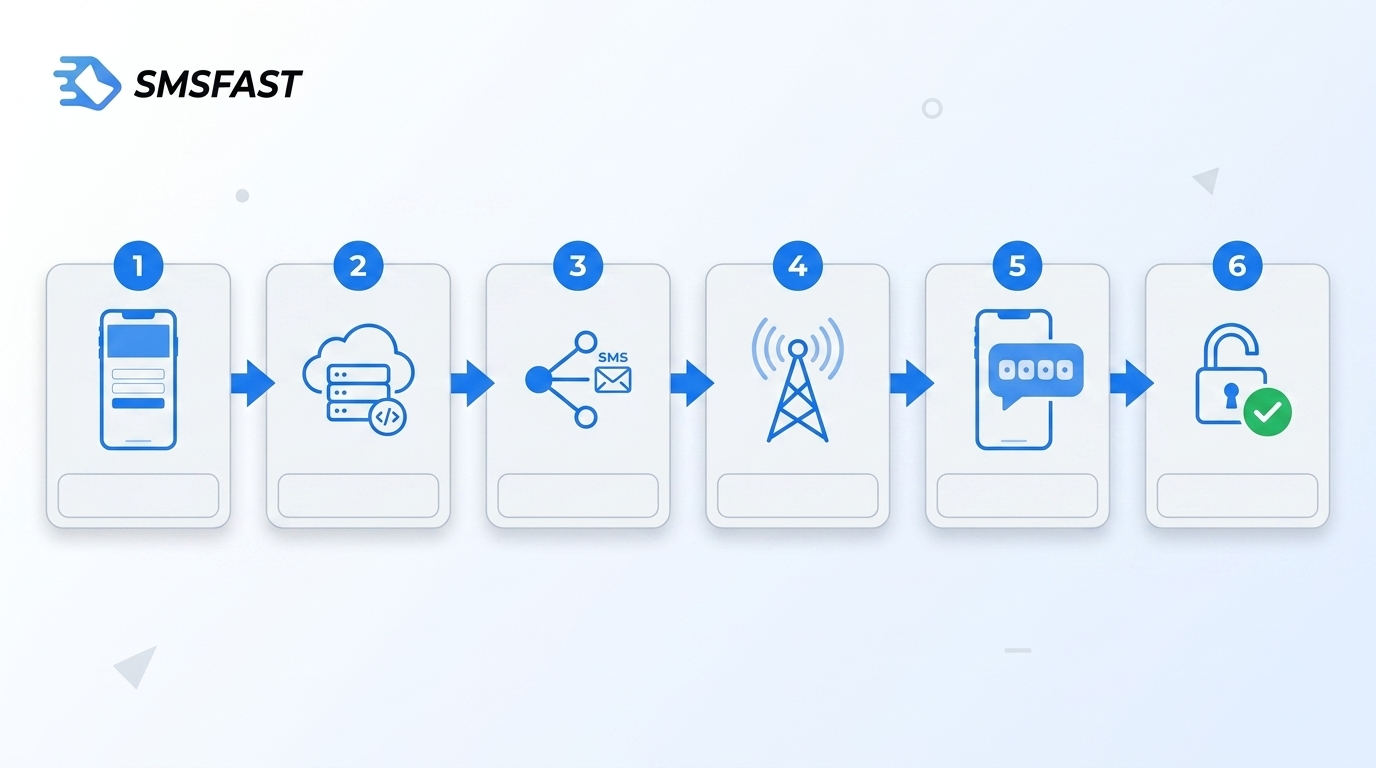
An SMS verification code follows a predictable cycle from request to access. Say you log in to a crypto exchange from a new location:
You enter your phone number or start the login.
The exchange server generates a short one-time code.
The code travels through an SMS gateway onto the mobile network.
Your registered phone receives the text.
You type the code into the login screen.
The server checks the code and grants or denies access.
The code stays valid only briefly. Platforms often cite a 5 to 10 minute window, though the exact interval depends on the implementation and can run shorter.
What is an SMS number? Understanding short codes and sender IDs
An SMS number is the sender address a platform texts your code from, and it comes in three forms. Long codes are standard 10-digit numbers. Short codes are 5 or 6 digit numbers built for high-volume texts. Alphanumeric sender IDs show a name instead of digits in some regions.
Big banks and crypto exchanges usually text from registered short codes or steady sender IDs. A legitimate sender is worth recognising, since an odd number from an unexpected source then stands out.
What is SMS authentication and why it's used
Banks and exchanges ask for an SMS code because a password on its own no longer keeps an account safe. As the second factor in two-factor authentication, an SMS code adds a check based on something you physically hold, your phone, on top of something you know, your password. That pairing pushed platforms to adopt text codes as a baseline defense.
SMS authentication in two-factor systems
SMS authentication works as the second factor in a two-factor setup, joining a password you know with a phone you hold. The FTC compares the two factors to a doorknob lock and a deadbolt: a thief needs both to get in.
Major exchanges and financial firms adopted SMS-based two-factor authentication as a minimum standard. It reaches nearly everyone, yet security teams rank it below app-based options.
What are verification codes used for? Real-world examples
Verification codes guard the moments when an account is most exposed. Financial and crypto apps call on them across several everyday actions:
Confirming a login on your exchange or banking app.
Resetting a forgotten password.
Clearing a security check after a suspicious login attempt.
Approving a withdrawal or a money transfer.
Different types of verification codes users encounter
Not every verification code arrives the same way. The delivery channel, whether text, voice call, or authenticator app, shapes how convenient the code feels and how well it resists attackers.
What is via SMS? Understanding delivery channels
"Via SMS" marks the option to receive your code as a text, sitting beside "via call" and "via app" in verification menus. An authenticator app protects a code better than either SMS or a voice call, since text and call both ride the carrier network where interception can happen. In December 2024, CISA advised against SMS as a second factor and pointed to authenticator apps and security keys instead, while noting that SMS during sign-up stays acceptable.
SMS still wins on reach, which counts when you have no SIM card on hand. A service like SMSFAST delivers the text code to a virtual number so you can verify without a physical SIM.
What is a verification number and how it differs from a code
A verification number and a verification code are two different things that platforms often blur. The verification number is the phone number where the code arrives. Your verification code is the numeric string you type to prove identity. "Enter your verification number" asks for your phone; "enter your verification code" asks for the OTP.
SMS codes compared to other verification methods
SMS codes, authenticator apps, and email codes each trade speed against security. The table below reads as a reference, not a scoreboard, since a low-stakes sign-up and a crypto wallet call for different choices.
Method
Speed
Security
Typical use
SMS code
Arrives in seconds, any phone
Lower, exposed to SIM swap
Everyday sign-ups, account recovery
Authenticator app
Fast, codes refresh every 30 to 60 seconds
Higher, built on your device offline
High-value logins, crypto and finance
Email code
Moderate
Tied to your email account security
Backup or convenience option
Authenticator apps generate codes offline, ahead of SMS. Email codes lean on how well you protect the inbox, so their standing against SMS shifts with your provider and settings.
Security risks: why SMS codes are not foolproof
SMS codes are convenient, and they are also the weakest link in most account security chains. A code sent over the carrier network can be redirected or read without your knowledge, which puts financial and crypto accounts squarely at risk. The medium carries the vulnerability, not the code itself.
Common vulnerabilities in SMS verification
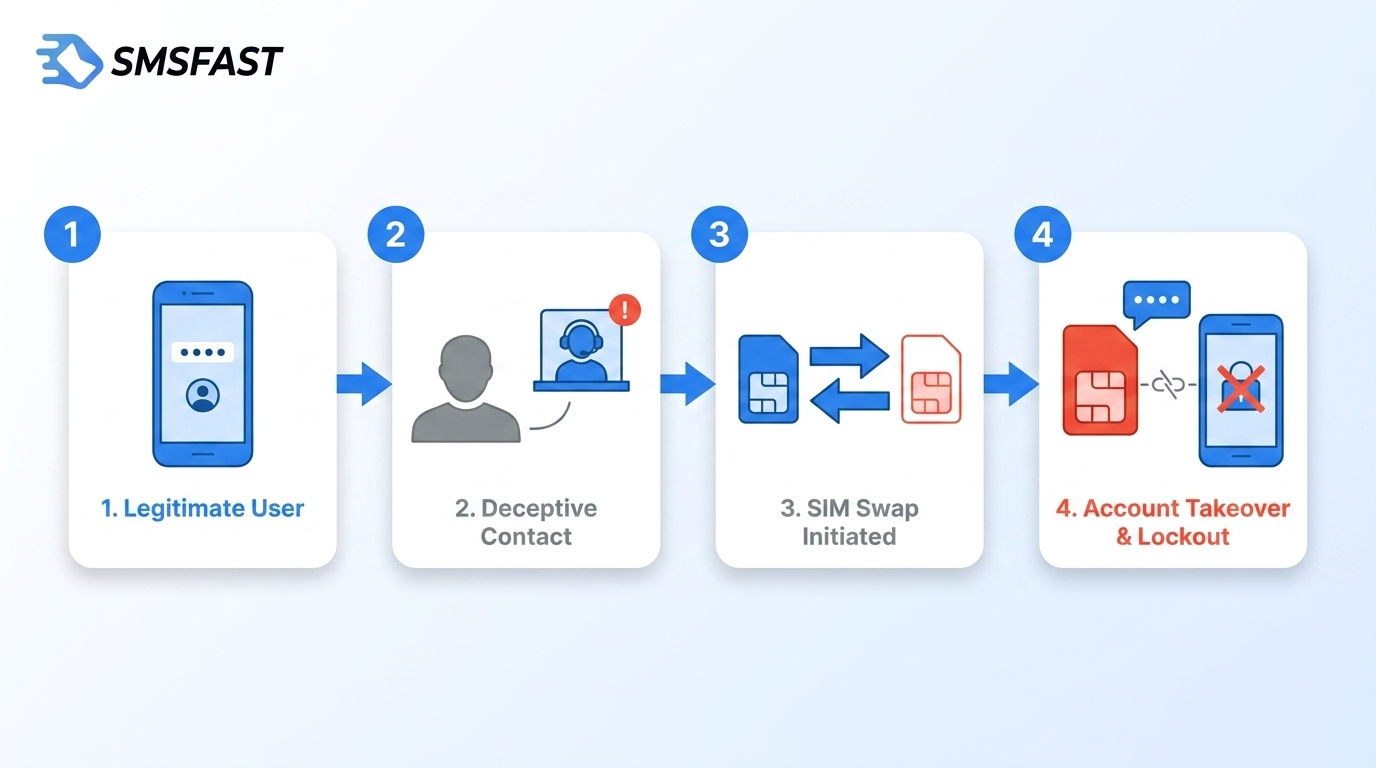
Two attacks explain why SMS codes fail. In a SIM swap, an attacker poses as you or bribes a carrier employee, then moves your number to a SIM card they control, so your incoming codes land on their phone. The victim often notices only after the account is gone.
The second weakness sits in the network itself. Flaws in SS7, the signaling protocol carriers use to route messages, can let attackers reroute or read texts, codes included. Neither attack needs your password first, which is what makes both dangerous. A virtual number kept apart from your main line limits the damage, covered in the guide on single-use virtual numbers.
Why blockchain transaction irreversibility raises the stakes for SMS code security
A stolen SMS code hurts far more when crypto is involved, because a confirmed blockchain transaction rarely reverses. Traditional finance often lets you dispute a fraudulent card charge through consumer protections. A confirmed transfer on Bitcoin or Ethereum offers no standard chargeback once it settles on chain.
That finality changes the math. An attacker who grabs your code and empties a wallet leaves a loss that is nearly impossible to recover, not a temporary account problem.
Why crypto and finance platforms are adding extra security layers
The industry is moving toward authenticator apps and hardware keys, driven by the documented weaknesses of text codes. Coinbase reported that 95% of its account takeovers as of November 2022 hit users on SMS-based multi-factor authentication. Security guidance increasingly points to TOTP apps and FIDO2 or WebAuthn hardware keys as stronger factors, while SMS still shows up widely for creating accounts and recovering access.
The shift is a broad sector trend, not a single named policy. Treat app-based codes or a hardware key as the upgrade path once an account holds value.
Best practices for using SMS codes safely
You can keep relying on SMS verification and still tighten how safely you use it. The steps below suit anyone protecting a financial or crypto account, and privacy-minded users receive SMS online to shield their main number. Practical control is the point here, not fear.
Practical steps to protect verification codes
A short checklist covers most of the protection an everyday user needs:
Never share a code with anyone, including a caller who claims to be support staff.
Turn on a SIM lock or carrier PIN so no one moves your number without it.
Shift high-value accounts to an authenticator app instead of SMS where the option exists.
Use a virtual number from a trusted service when signing up on unfamiliar platforms, so your real number stays private. Compare current number pricing before you register.
Your real number stays safer when you keep it off unfamiliar sign-up forms. SMSFAST supplies virtual numbers built for SMS verification, and new users get $0.25 by subscribing to the SMSFAST Telegram channel, enough to test a first number before adding funds.
Frequently Asked Questions
What is an SMS code on a phone?
An SMS code on a phone is a short numeric one-time password, usually 4 to 6 digits, that a platform texts you to confirm your identity. You type it into a login or sign-up screen. The code works once and expires within minutes, though the exact window depends on the platform.
Are SMS codes secure for authentication?
SMS codes add real protection over a password alone, yet they rank as the weakest common second factor. SIM swap attacks and network flaws let attackers intercept texts. CISA advises moving to a stronger option where one exists, such as an authenticator app or a hardware key.
What should I do if I receive an SMS code I didn't request?
An unexpected SMS code often means someone entered your number, sometimes after a failed login on your account. Do not share the code or tap any link in the message. Check the real account for unusual activity, and change your password if login alerts follow.
What is the difference between an SMS code and an OTP?
An OTP is any single-use one-time password; an SMS code is an OTP delivered by text message. Each one counts as an OTP, yet an OTP can also arrive by email or generate inside an authenticator app. The label follows the delivery channel, not the code itself.
OTP bots are automated tools sold on Telegram for $10-$50 per session that intercept your 2FA codes in real time. Learn how they work, which industries they target, and how to stop them.
Cash App allows one verified account per SSN, not per phone or email. See the real rules, the legitimate business-account path, and what happens if you break policy.