Guides
How to get a virtual phone number for your business in 2026
Get a virtual phone number in five steps. Compare types, costs, and features, then pick a provider for remote and hybrid teams.
Jul 02, 2026 · 15 min read
Renting a virtual phone number beats buying one for most people in 2026. A virtual phone number runs over Voice over Internet Protocol (VoIP), so no provider truly sells you the number outright.
Under U.S. Federal Communications Commission number portability rules, a phone number is a portable identifier that can move between providers rather than fixed property tied to one carrier. Price, portability, and your use case decide whether buying or renting wins for freelancers, expats, job seekers, and call centers.
A virtual phone number is a cloud based telephone number that sends calls and texts over the internet instead of a copper line or a SIM card. The number lives in your provider account, not in a single device, so it reaches any phone, laptop, or tablet you connect. Because the number binds to an account rather than a device, you keep the same line whether you switch phones or move country.
Call forwarding routes each incoming call to the destination you set, and Caller ID shows your chosen number to the person you dial. Support for calls, texts, or both depends on the plan you pick.
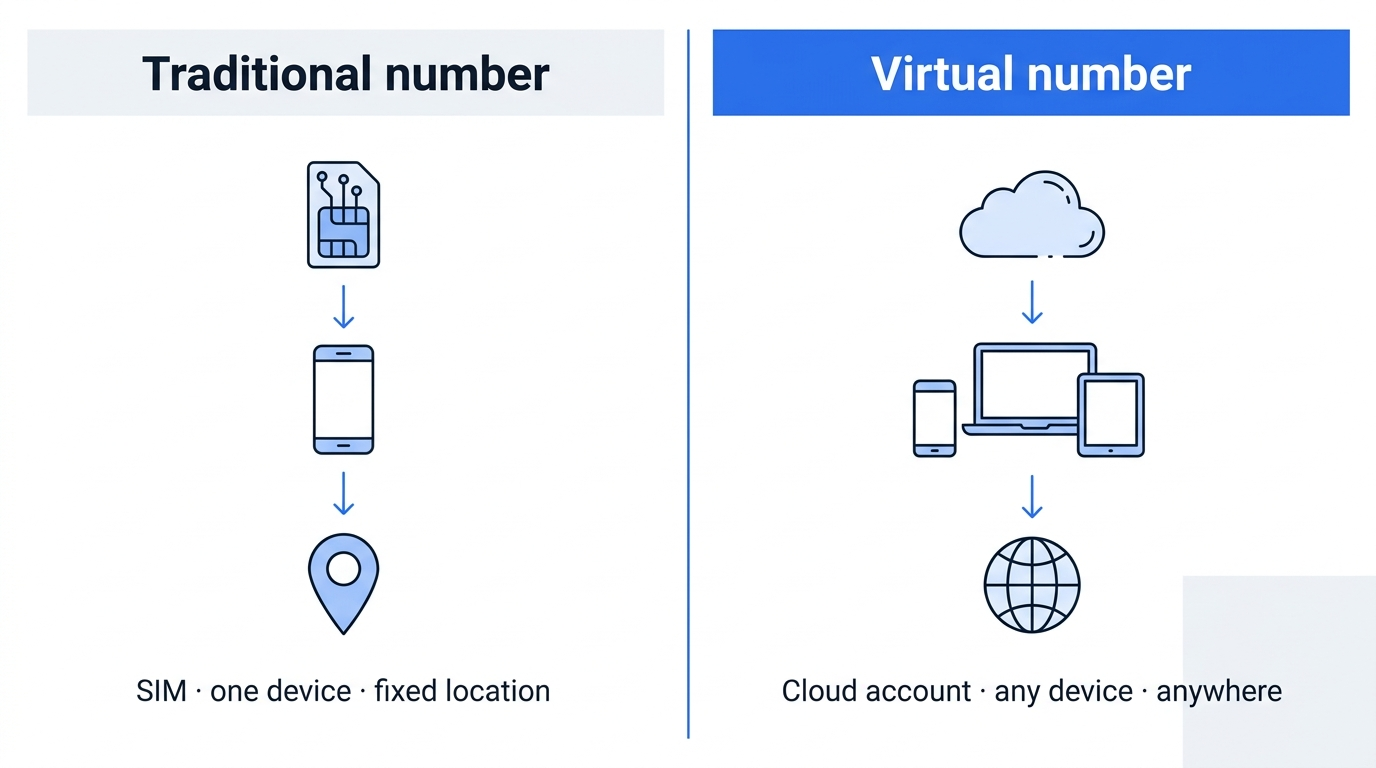
For a full breakdown of how these numbers work, see the SMSFAST guide on what a virtual phone number is.
Voice over Internet Protocol converts your voice into a digital signal, sends it across the internet, and rebuilds it as sound at the other end, according to the FCC VoIP consumer guide. VoIP works like email for your voice: the message travels as data packets and reassembles on arrival.
A softphone runs that same VoIP call as an app on a phone or computer, turning any device into a VoIP phone with no handset required. VoIP is the technology, and the virtual phone number is the identifier that rides on top of it.
A virtual local phone number carries the area code of a chosen city, so callers see a nearby number rather than an out of area one. Take a consulting firm in Austin: it can run a New York 212 number and answer as a local business.
A familiar local area code is more recognizable than an unknown or international one, which can encourage more callbacks. Running a US based virtual phone number costs a fraction of a physical branch in the same city.
An international virtual phone number carries another country's code and routes calls to wherever you are. Expats in the United Arab Emirates can hold a Philippines number so family members call at local rates instead of paying international tariffs.
Travelers and remote workers keep a home country number active on WiFi without roaming fees. The number stays reachable as long as your internet connection stays up.
A virtual phone number is the identifier, while a virtual phone system is the full cloud platform that manages many numbers, menus, and teams. Think of the number as a street address and the system as the post office that sorts everything.
A virtual phone system adds Voicemail, Caller ID, IVR (interactive voice response) menus, and team integrations that a single number does not need. Most individuals and small businesses only need the number, so start there rather than with a platform like RingCentral.
| Feature | Virtual phone number | Virtual phone system |
| Includes | One number, Call forwarding, Caller ID | Many numbers, IVR, Voicemail, team tools |
| Best for | Individuals, freelancers, small teams | Growing companies with call routing needs |
| Typical 2026 price | About $3 to $15 per month | About $20 to $50 per user per month |
You never own a virtual phone number the way you own a SIM card, so "buy" and "rent" describe two billing models rather than true ownership. Buying means committing to a long term plan and porting the number so it follows you between providers.
Renting means paying month to month or pay as you go with no long commitment. A landline stays chained to one address, while a virtual phone number moves with your account.
Buying a virtual phone number online means moving to annual billing, porting in an existing number, and paying a one time connection fee plus a subscription. Number portability is the closest thing to ownership: your number travels with you when you switch providers.
The FCC number porting rules require simple ports to finish in one business day, while more complex ports can take up to four business days. Do not cancel your old service until the port completes, or you risk losing the number. A short overlap during a one business day port is normal and costs little.
Renting a virtual phone number means paying a small monthly fee or a pay as you go rate for as long as you keep the number. Monthly billing is the most common model because it carries no annual lock in and starts cheap.
A rented number gives freelancers, travelers, and testers full flexibility to cancel once the need ends. Renting is not a second tier option: it is the default choice for anyone whose plans might change.
Rent when your need is short or uncertain, and buy when the number anchors a long term brand or account. Weigh four factors: how long you need the number, your call volume, the country or area code you require, and how much portability matters. A rented virtual phone number service suits sign ups and trials, while a purchased number suits a published business line you cannot afford to lose.
| Factor | Buy (long term plan) | Rent (monthly or pay as you go) |
| Commitment length | 12 months or longer | 1 day to 1 month, renewable |
| Cost structure | One time fee plus annual rate | Small recurring fee only |
| Portability | Strong, number ports with you | Limited on short rentals |
| Best scenario | Published business line | Sign ups, travel, testing |
| Cancellation flexibility | Lower, tied to the term | Higher, cancel any time |
| Activation speed | Minutes after verification | Minutes after verification |
Four rules settle most decisions:
Five user profiles cover almost everyone who needs a virtual phone number, and each one leans toward buying or renting for a clear reason. Call forwarding and Caller ID give every profile a professional front, and a softphone removes the need for a second device.
The right model tends to follow how long the number stays in use and how visible it becomes to clients or contacts. Freelancers, startups, expats, job seekers, and call centers each map to a smarter default.
A dedicated virtual phone number keeps your personal number private and puts a professional line in front of clients. Picture a freelance designer in India: a US Caller ID lets American clients reach a familiar number. Call forwarding sends those calls to your existing phone, and a softphone answers them without a second handset.
A cheap virtual phone number also separates client calls from personal ones, so evenings stay off the record. Monthly rental almost always wins here, since a solo workload shifts often.
A virtual phone number lets a startup enter a new market and route calls through Call forwarding without renting an office there. One Berlin startup might display a US number and test American demand before committing to infrastructure.
Caller ID with a local area code shapes how prospects perceive the brand from the first ring. Test a market for 60 to 90 days on a rented number before you scale.
A virtual phone number in your home country keeps banks, doctors, and family reachable without roaming charges. Many banks still tie account verification to a home country number, so a parent in Dubai keeps that line for logins.
A digital nomad in Southeast Asia holds the same number across every border. The number stays available wherever an internet connection reaches.
A local virtual phone number that matches the employer's region raises the odds a recruiter calls back. An applicant in Nigeria applying for a role in the United Kingdom can show a UK Caller ID instead of an international number. Recruiters answer and return calls to familiar local numbers more readily than to unknown foreign ones.
The displayed number, set by Caller ID, drives that first decision to dial back. A short monthly rental covers a job search well, since the need ends once the offer lands.
Regional virtual phone numbers build local trust, cut abandoned calls, and scale support without matching growth in hardware. A support team in Mexico can run New York, California, and Texas numbers so each region sees a local line.
Call forwarding and Caller ID direct every call, and a VoIP phone replaces the physical lines an office once needed. One dashboard manages every number at once.
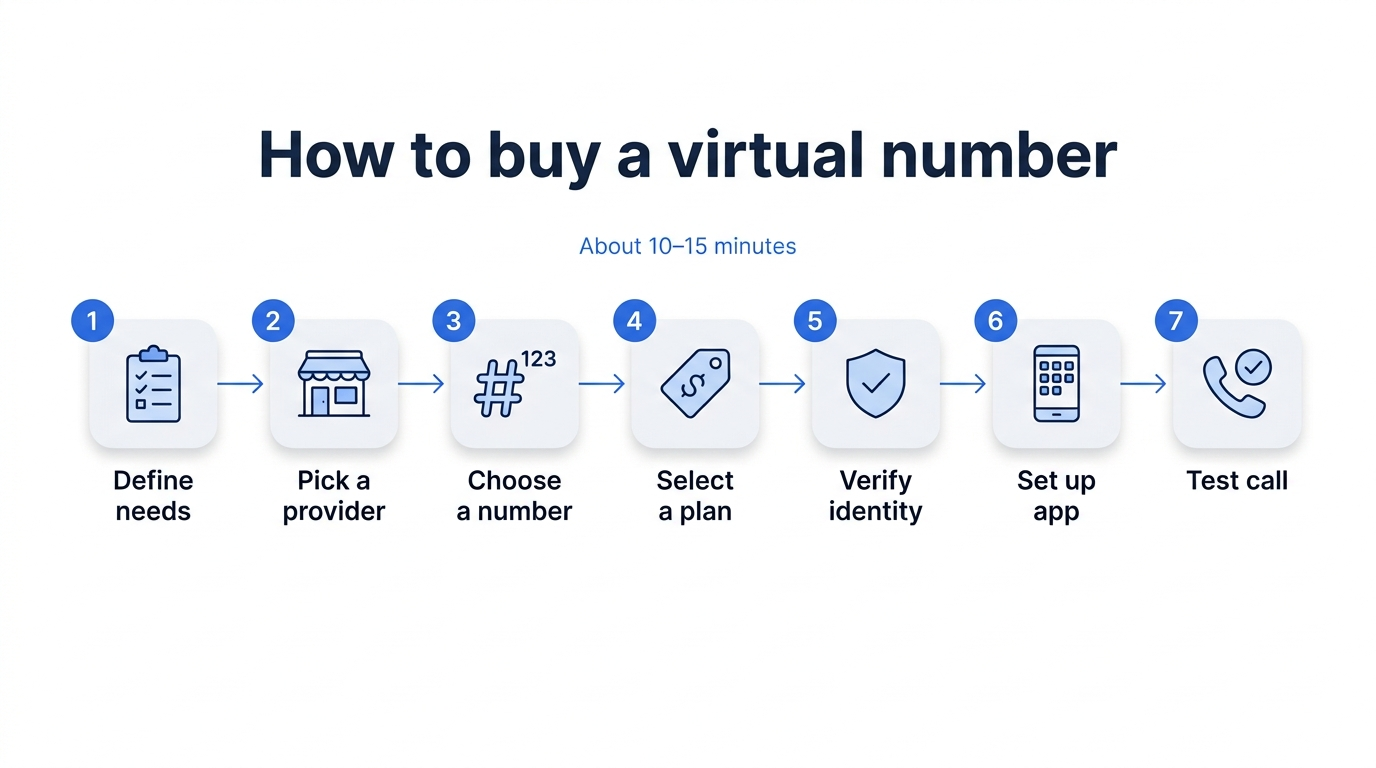
Buying a virtual phone number online takes about 10 to 15 minutes across seven steps, with instant activation standard in 2026. Seven steps take you from zero to a working line:
For a deeper operational walkthrough, see the SMSFAST guide on how to get a virtual phone number for your business.
Most people need no extra hardware, since a smartphone, computer, or tablet with internet runs the number through a softphone. A softphone functions as a VoIP phone in software, and VoIP itself uses your existing internet connection.
Desk phones and headsets only earn their place in offices with high call volume. New users can start on day one with the device already in their pocket.
Score a virtual phone number service on five criteria, not price alone, before you sign up. Pricing model, country coverage, call quality, contract terms, and setup time form the standard evaluation matrix.
Skipping any one of these checks tends to surface later as a hidden fee, a dropped call, or a locked contract. Run each check during a free trial where the provider offers it.
Match the pricing model to your call pattern: a flat monthly rate suits regular users, per minute suits rare callers, and pay as you go suits short term needs. Providers often bundle SMS, video meetings, and team chat into tiers that a single number user never touches.
Voicemail sits in many base plans as an add on you may not need. Pay for the calling pattern you actually have, not the feature list.
Confirm the country and area code exist in a provider's inventory before you register, because coverage varies widely. Providers sell three main types: a local number, a Toll-free telephone number, and a vanity number with custom, memorable digits.
A Toll-free telephone number charges the call to you, the owner, rather than the caller, per FCC rules. Wireless callers may still use plan airtime minutes unless they hold an unlimited plan. Check availability first so a trial does not stall on a missing area code.
Call quality tracks the provider's VoIP infrastructure, server locations, and codec support. A well configured VoIP call in 2026 sounds the same as a traditional call, which retires the old complaint that VoIP sounds poor.
Voice over IP carries the audio, and a VoIP phone or softphone delivers it to your ear. Test the line on a free trial before you trust it with clients.
Read the cancellation clause before you subscribe, since the terms decide how easily you can leave. A monthly plan gives maximum flexibility, and an annual plan trades that for a lower rate once you trust the provider.
Automatic renewal and no refund policies are the two clearest warning signs. Start on a monthly plan and move to annual only after the service proves itself.
Setup time is an underrated criterion that separates strong providers from weak ones. The best services activate a virtual phone number in 10 to 15 minutes with no technical skill required.
A softphone that works on day one signals a provider that respects your time. Slow, confusing onboarding is an operational risk, not a minor annoyance.
A virtual phone number protects your privacy by separating your identity from the number you hand out in public. Caller ID controls what recipients see, Call forwarding keeps your real line hidden behind the virtual one, and Voicemail stores messages without exposing your personal number.
Separating your identity from your public number matters most when you register on unfamiliar platforms.
A virtual phone number delivers four privacy gains:
For registration and SMS verification specifically, a temporary number shields your real one from unknown services and keeps it off resale and marketing lists. SMSFAST supplies virtual numbers built for exactly that job, and you can read more on disposable phone numbers before you register anywhere new.
A virtual local phone number costs between about $3 and $15 per month in 2026, depending on region and plan. Toll-free numbers cost more, often $10 to $30 per month plus per minute usage, and a vanity number can run higher still.
Google Voice stays free on its personal plan, and Google added two paid personal plans in July 2026, Voice Starter at $10 per month and Voice Standard at $20 per month. Personal Google Voice is restricted to users in the United States and requires an existing US phone number to sign up, so expats and non US users cannot use it. Pricing verified as of August 2026.
Hidden costs decide the real bill more than the headline rate:
| Region | Number type | Typical monthly cost (2026) | Best for |
| United States | Local virtual number | $3 to $15 | Freelancers, local presence |
| United States | Toll-free number | $10 to $30 plus usage | Customer service lines |
| Europe | Local virtual number | $6 to $20 | Cross border small business |
| Global | Virtual number, number only | $3 to $15 | Sign ups, single line users |
| Global | Virtual phone system, full platform | $20 to $50 per user | Teams needing IVR and routing |
Renting a virtual phone number is the smarter choice for most readers. The buy or rent label matters less than three things underneath it: portability, a plan that fits your real call pattern, and paying only for what you use. Buying earns its place when a number anchors a long term business line you cannot afford to lose.
Portability, protected by FCC rules, is the real asset in either model.
If your goal is protecting your real number during sign ups rather than running a full calling line, SMSFAST supplies virtual numbers built for SMS verification. Get your free $0.25 bonus: subscribe to the SMSFAST Telegram channel and test your first number before you top up.
You get a virtual phone number by choosing a provider, selecting a number and country, verifying your identity, and configuring Call forwarding. The full process takes about 10 to 15 minutes with instant activation. Most providers run entirely through a web dashboard or mobile app.
A local virtual phone number costs between about $3 and $15 per month in 2026. Toll-free numbers run higher, often $10 to $30 per month plus per minute usage. Expect about $20 to $50 per user per month for a full virtual phone system with IVR and routing.
A virtual phone number keeps your personal number private, creates a professional local presence, and forwards calls to any device. Caller ID lets you control the number others see. The number reaches you anywhere an internet connection works, with no roaming charges.
Yes, Google Voice offers a free personal plan with a US number for calling, texting, and Voicemail. But Google limits personal Google Voice to users in the United States and requires an existing US number to sign up, so expats and non US users cannot use it. Paid plans Voice Starter ($10) and Voice Standard ($20) launched in July 2026.
Yes, a virtual phone number is legal and regulated like traditional phone service in most countries. Using one for illegal activity stays illegal. Some countries restrict local numbers to residents or registered businesses, so confirm local rules before you buy.
A virtual phone number is a cloud based number that runs over VoIP and forwards calls to any device. The wider virtual phone system manages many numbers, IVR menus, and teams. Most individual users only need the number, not the system.
Buying means a long term plan with a ported number and a one time connection fee, closest to ownership through portability. Renting means a monthly or pay as you go fee with no lock in. Short rentals fit uncertain needs, while a purchase fits a permanent published line.
Yes, most providers sell US based virtual phone numbers and local numbers for many other countries. Confirm the exact country and area code exist in the provider's inventory before you register. Some countries limit local numbers to residents or registered businesses.
Yes, a virtual phone number depends on an internet connection and may fail during an outage. The FCC warns that VoIP 911 service can carry limitations and needs an accurate registered address. Some banks and apps also reject VoIP numbers for verification.
No single virtual phone number service ranks best for everyone, since the right pick depends on your country, call volume, and budget. Score each option on price, coverage, call quality, contract terms, and setup time. Start on a monthly plan and test the service before you commit to a year.
Get a virtual phone number in five steps. Compare types, costs, and features, then pick a provider for remote and hybrid teams.
Telegram's "Too many attempts" error is a temporary rate limit, not a ban. See exactly how long it lasts, the fastest fix, and how to stop it from happening again.