A phone buzzes at checkout, and the screen reads "Your OTP is 4521." That short code is an SMS OTP, a one-time password texted to confirm a person controls the account. It delivers Two-Factor Authentication (2FA) across banking, social, and shopping platforms. SMSFAST receives these codes, carried over the SMS Network, on virtual numbers in 190+ countries.
Key takeaways
SMS OTP is a one-time code that verifies account access.
Each code expires within minutes, often 5 or fewer.
The code adds a second factor beyond a static password.
Phishing and SIM-swap attacks target these codes.
No legitimate service asks a user to share a code.
What does OTP mean in a text? Understanding the basics
OTP means one-time password, a temporary code a service sends to confirm account ownership. Services issue an SMS OTP because a code tied to a registered number proves the person at login holds the phone, the second factor in Two-Factor Authentication (2FA). An OTP works like a key that opens a door once, then stops. Terminology shifts across platforms, though the mechanism stays identical.
OTP SMS meaning explained simply
OTP spells out as O-T-P: one, time, password. An OTP verification code differs from a permanent password in two ways. A code covers a single login, then expires. That short life is the point, since a stolen code loses value within minutes.
What does OTP mean on text messages across different platforms
Different platforms label the same code with different words. Banking apps use OTP for logins, transfers, and transaction approval. Consumer services often print "verification code" for the identical mechanism. "One-time passcode" and "access code" appear as documented synonyms in login and session contexts. In each category, the code provides a Two-Factor Authentication step beyond the password.
Common labels across platform categories:
Banking apps text an OTP to approve logins, transfers, and payments.
E-commerce checkouts send a verification code before confirming an order.
Social platforms request a passcode during sign-in or account recovery.
Authenticator apps generate the same code type as a time-based alternative to SMS.
How mobile OTP works behind the scenes
Mobile OTP follows a five-stage lifecycle from request to expiry. The SMS Network carries the code between the service and the handset, and SMSFAST sits inside this chain as the reception layer on a virtual number.
A user requests a code at login or checkout.
The service generates a unique SMS OTP tied to that session.
The SMS Network routes the code to the destination number.
The service checks the code the user enters.
The code expires once used or once its window closes.
The journey of a text message OTP: from request to verification
Seconds pass between a tap on "send code" and the arriving text. On premium US 10DLC routes, an SMS OTP reaches the phone with a median latency near 6 seconds, rising to 28 to 45 seconds at the 99th percentile, per a 2026 benchmark cited by delivery-infrastructure analysis. Short-code routes run faster, near a 2-second median. SMSFAST catches the inbound code the moment the SMS Network completes delivery.
OTP phone verification: why timing and expiration matter
Expiration works as a deliberate security design, not an inconvenience. A standard SMS OTP expires after a short window, often capped at 5 minutes, with web-security guidance recommending 30 to 120 seconds for higher-risk flows. Authenticator Apps run tighter windows of 30 to 60 seconds using time-based codes. Once a code lapses, the standard step is a fresh request, and the expired code cannot return to use.
Where SMS OTP texts appear in everyday applications
SMS OTP shows up wherever a service verifies identity: banking, e-commerce, and social media. Two-Factor Authentication is the primary, widely used context for these codes. Recipients meet OTP texts at login, at password reset, and at payment approval across each vertical.
What are OTP texts used for? Common use cases
OTP texts secure four everyday actions, each sitting inside a broader multi-factor authentication frame.
Login verification confirms the person signing in controls the account.
Password reset checks identity before a new password takes effect.
Payment confirmation approves a transaction before funds move.
Account recovery restores access after a lockout or a lost credential.
Multi-factor authentication wraps these steps, with SMS OTP acting as one verification layer.
What is OTP on my phone? Recognizing legitimate vs. suspicious codes
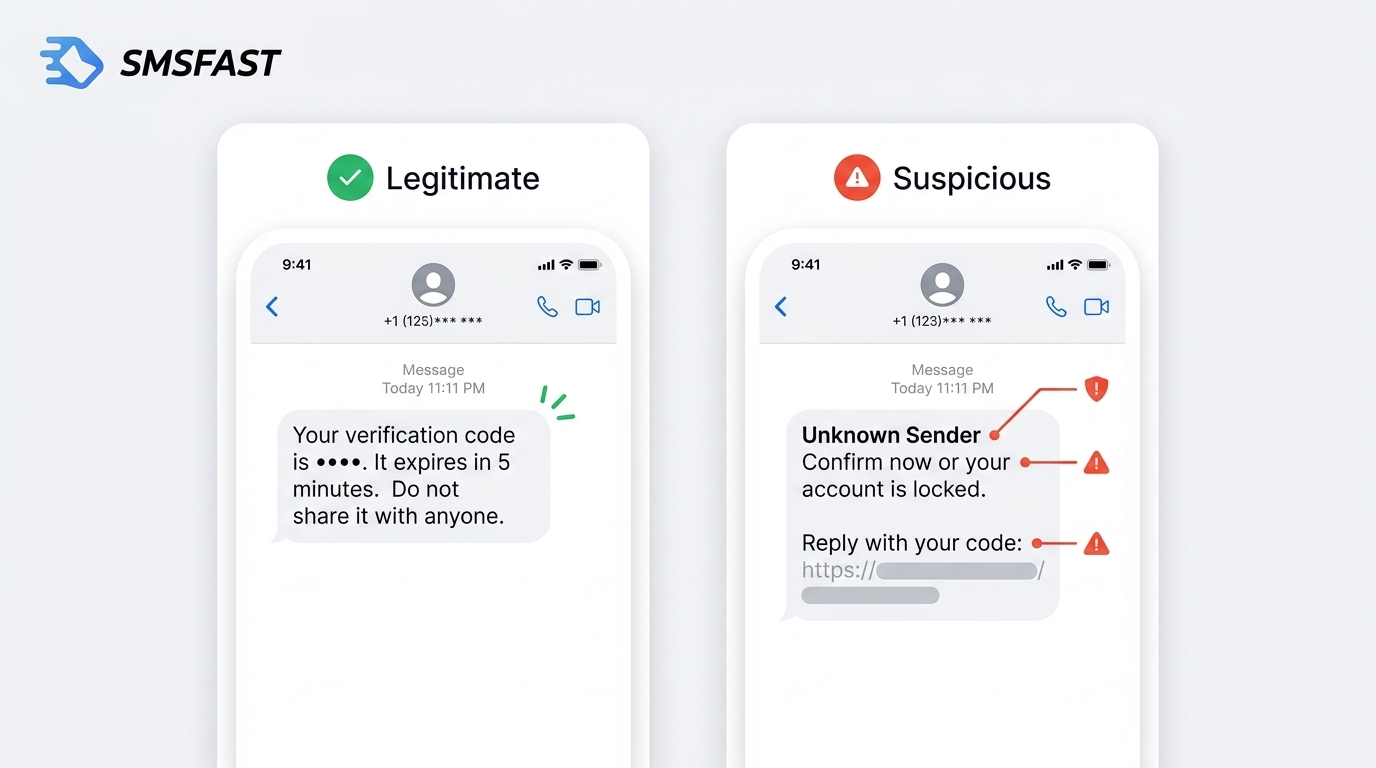
A legitimate SMS OTP arrives right after a login or purchase the user started. A suspicious code arrives unprompted, or a message asks the recipient to read the code back. Phishing Attacks trade on that confusion to capture codes.
Warning signs of a scam OTP:
An unexpected sender texts a code no one requested.
A caller or message asks the recipient to share the code.
Urgent language pressures a fast reply.
A separate attack, OTP bombing, floods a target with genuine codes to bury a real login alert or push the person toward a fake support call.
Among the unique text messages UK users flagged to the 7726 reporting service in a 2025 study, 40.27% were scams. For one-time sign-ups on unfamiliar services, a disposable phone number keeps a personal line off scam and marketing lists.
What are OTPs on my phone? Formats and variations explained
OTP codes arrive in three formats: numeric, alphanumeric, and link-based. Numeric codes suit banking and consumer logins for their broad device support. Users of virtual numbers for receiving OTP online meet all three formats depending on the platform. The SMS Network carries every format to the destination number.
What is an OTP on my phone vs. a regular verification code
Two labels describe one mechanism: OTP and verification code. A service that texts an SMS OTP and one that texts a "verification code" both send a short, single-use, expiring code. No practical difference separates the two labels. The wording tracks industry habit, not function.
OTPs text formats: numeric, alphanumeric, and link-based
Three OTP formats trade compatibility against richness. Numeric codes tend to work on more carriers and devices than the other two formats. Alphanumeric codes pack more entropy, though the SMS Network in several countries filters alphanumeric Sender IDs. Link-based codes verify with a single tap yet depend on a data connection.
Format choice at a glance:
Numeric: broad carrier support, suited to global reach.
Alphanumeric: richer codes, risk of carrier filtering.
Link-based: single-tap check, needs internet access.
The way an OTP generator builds a code shapes both delivery speed and filter compatibility.
SMS OTP vs. other one-time password methods
SMS OTP competes with app-based TOTP, email OTP, and push notifications on speed, security, cost, and friction. Any one-time password method beats a static password, since a reused password stays valid until changed. The table below sets the four methods side by side.
Method
Speed
Security
Cost
User friction
SMS OTP
Seconds
Moderate, carrier-dependent
Per-message
Low, no app
App OTP (TOTP)
Instant
High, local code generation
Free app
Setup required
Email OTP
Seconds to minutes
Moderate, tied to inbox
Low
Inbox check
Push notification
Instant
High
App infrastructure
Smartphone plus app
The "Seconds" figure for SMS OTP reflects median latency on premium routes; delivery can stretch to 30 seconds or more at the 99th percentile or on congested networks.
Messaging OTP vs. email OTP vs. app-based authenticators
Authenticator Apps generate TOTP codes locally, so a code never crosses a carrier network, which lowers interception and SIM-swap risk. That local design does not make TOTP absolute: it stays open to phishing and real-time relay attacks.
Email OTP suits low-stakes recovery yet inherits the security of the mailbox. SMS OTP reaches more devices than app-based methods, including feature phones with no app support, which keeps it useful for broad user bases.
What is OTP in messaging apps like WhatsApp and Telegram?
WhatsApp and Telegram both fold OTP verification into their own sign-in and recovery flows as a Two-Factor Authentication step. A structural irony sits here: messaging apps consume SMS OTPs delivered over the SMS Network to guard their own accounts, and also send verification codes through their own messaging APIs as an alternative to SMS.
Users registering on these apps through a virtual number receive that login code on SMSFAST. The SMSFAST WhatsApp verification page walks through that flow.
Phone OTP security: can SMS codes be intercepted?
SMS OTP carries real, documented risks, though their scale stays manageable with basic care. SIM-swap fraud and Phishing Attacks form the two main threats to codes traveling over the SMS Network. Both attacks target the link between a phone number and its rightful owner rather than breaking the code itself.
A third risk sits in the network itself: known SS7 signaling weaknesses let well-resourced attackers intercept or redirect SMS, though that risk concentrates on high-value targets.
SIM-swap attacks and SMS OTP vulnerability explained
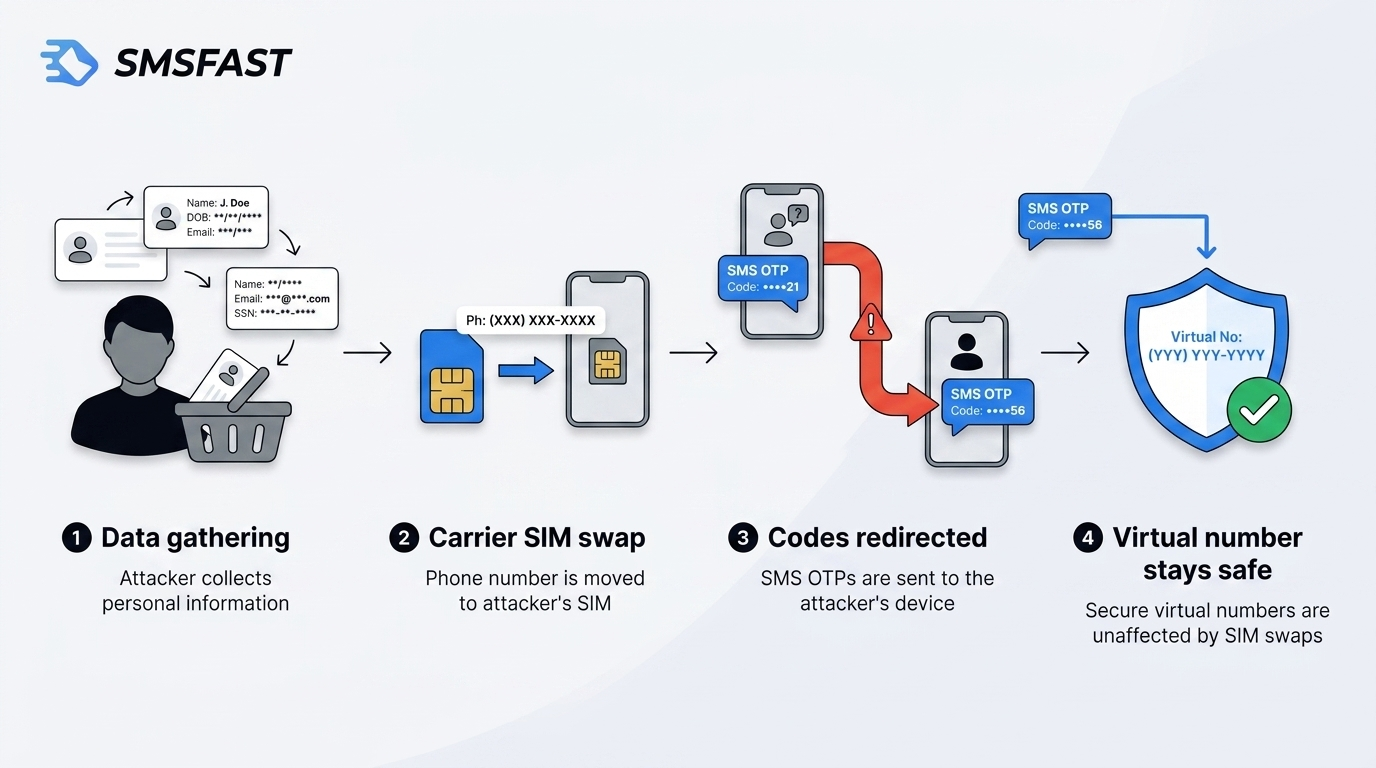
A SIM-swap attack hijacks a phone number to intercept its codes.
An attacker gathers personal data on a target.
The carrier moves the number to the attacker's SIM.
Incoming SMS OTP codes reach the attacker.
The FBI's Internet Crime Complaint Center logged 982 SIM-swap complaints and about $26 million in reported U.S. losses in 2024, down from a $72.6 million peak in 2022. A virtual number hosted apart from the carrier SIM blunts this attack, since a carrier SIM swap reaches no separately hosted line. Virtual numbers for receiving OTP online sit outside the swap path.
OTP meaning on the phone when fraud is suspected
An unrequested SMS OTP signals someone may already hold the account password. A clear response limits the damage:
Withhold the code from anyone who asks.
Contact the service through its official channel.
Change the account password at once.
Add an authenticator app or stronger MFA.
When a code never arrives, a fresh request or a coverage check usually clears it.
$0.25 Gift!
Subscribe to our Telegram channel and receive $0.25 on your balance.
OTP on the phone: best practices for businesses and product teams
Product teams choosing an OTP channel weigh delivery reliability, device reach, and cost. SMS OTP fits verification flows that must reach any handset, and SMSFAST supplies an SMS reception layer for testing those flows, with an automatic refund when a code fails to arrive. Sound implementation, not the channel alone, decides how well OTP performs.
On the phone OTP delivery: SMS vs. push notifications for products
SMS and push notifications split along cost, device reach, and security. SMS OTP rides the SMS Network and reaches feature phones with no app installed. Push notifications cost less per message and resist interception, yet need a smartphone with the service's app already installed. Device reach tends to decide the choice for a broad, mixed audience.
What is OTP on phone systems for enterprise verification
Enterprise OTP systems succeed on disciplined implementation, with the code serving as one Two-Factor Authentication factor. Five core practices anchor a resilient setup:
Rate limiting caps how many codes one account can request.
Retry logic resends a code through a backup route on failure.
Fallback channels switch to voice or email when SMS stalls.
Audit logging records each request for later review.
Expiry tuning matches the code window to the risk level.
SMSFAST fits this stack as an SMS reception layer for verification testing.
What is OTP SMS? International contexts and delivery troubleshooting
Text-message codes reach users worldwide, and local terminology signals that reach. Indonesian web material uses "sms otp adalah" as a defining phrase for SMS-delivered one-time passwords. Delivery behavior shifts by country: each destination needs the correct country code, and local number formats decide whether a code routes at all. Several markets also apply their own Sender ID rules, so a format that arrives instantly in one country stalls in another. SMSFAST operates across 190+ countries, so delivery troubleshooting matters as much as terminology.
OTP phone troubleshooting: why codes are not being received
Undelivered OTP codes usually trace to a short list of causes, ordered here by likelihood:
A wrong number or a missing country code sends the code nowhere.
Carrier filtering or a spam filter blocks the message.
Network congestion or weak coverage delays delivery.
An overloaded SMS gateway drops or queues the code.
A device issue such as do-not-disturb or a full inbox hides it.
A routing or Sender ID misconfiguration stops delivery.
On SMSFAST, an activation number whose code never arrives triggers an instant automatic refund to balance, with no support ticket required. The SMSFAST pricing page lists reception options by service.
The future of SMS OTP and emerging authentication alternatives
SMS OTP keeps its place even as passkeys, biometrics, and authenticator apps spread. Passkeys build on the FIDO2specification, an open authentication standard from the FIDO Alliance. Major vendors position passkeys and FIDO2 as a phishing-resistant alternative to passwords and one-time codes.
Regulation has shifted too. NIST's SP 800-63B-4 guidelines classify SMS one-time passcodes as a restricted authenticator, permitted only with a documented risk assessment, a migration plan, and user notification. Network-level silent authentication, standardized through the GSMA Open Gateway Number Verify API, verifies a number without any code to enter.
For services with a broad, mixed audience, SMS OTP stays a primary channel in the near term, since it reaches any phone without setup.
Conclusion
SMS OTP remains a practical verification tool because it reaches nearly any phone and confirms account access in seconds. The security limits are real, so pairing the code with sound habits and stronger factors on high-value accounts makes sense.
SMSFAST supports private SMS verification across 190+ countries. The SMSFAST pricing page lists options by service and country.
$0.25 Gift!
Subscribe to our Telegram channel and receive $0.25 on your balance.
Frequently Asked Questions
What is an SMS OTP message?
An SMS OTP message carries a one-time password, a short code a service texts to verify identity. A code holds 4 to 6 digits and usually expires within 5 minutes or less. The code confirms account access, then stops working after a single use.
Is SMS OTP safe?
SMS OTP adds protection against password-only attacks, though it faces SIM-swap and phishing risks. The FBI's IC3 logged about $26 million in reported U.S. SIM-swap losses in 2024 (FBI IC3). Pairing it with an authenticator app raises safety on high-value accounts.
How long is an SMS OTP valid?
An SMS OTP usually stays valid for a few minutes, often capped at 5 minutes, with tighter windows for higher-risk flows. Authenticator app codes refresh faster, within 30 to 60 seconds. Once the window closes, the service needs a fresh code, and the old one cannot return to use.
What should be done if an SMS OTP is not received?
A missing SMS OTP usually points to a wrong number, carrier filtering, or network congestion. A fresh request after a number recheck resolves the issue. On SMSFAST, an undelivered activation code triggers an instant automatic refund to balance.
What are the main disadvantages of SMS OTP?
SMS OTP depends on carrier delivery, so congestion can delay codes past 30 seconds. It also faces SIM-swap and phishing interception that app-based TOTP resists through local code generation. These codes still reach feature phones that authenticator apps cannot.
Daniel Moore
Privacy & SMS Verification Researcher at SMSFAST
Privacy & SMS verification researcher at SMSFAST. Writes practical guides on virtual numbers, OTP delivery issues and keeping your personal number private.
An SMS code is a short numeric one-time password sent by text to verify your identity. Learn how it works, where it's used, its security risks, and safer alternatives.
OTP bots are automated tools sold on Telegram for $10-$50 per session that intercept your 2FA codes in real time. Learn how they work, which industries they target, and how to stop them.