


Guides
Cash App: Can You Have Multiple Accounts?
Cash App allows one verified account per SSN, not per phone or email. See the real rules, the legitimate business-account path, and what happens if you break policy.
Aug 18, 2026 · 23 min read
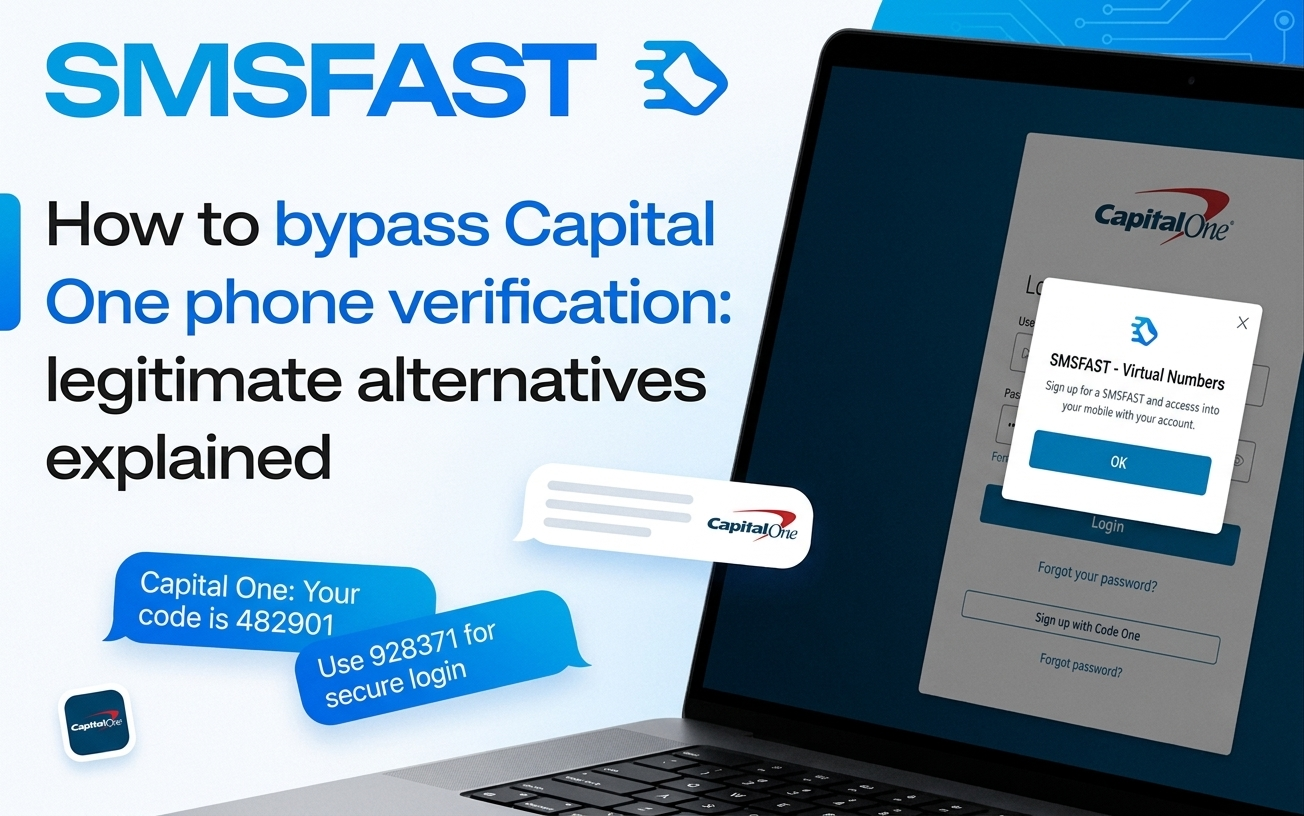
Quick answer: Capital One phone verification cannot be skipped, because the bank uses an SMS one-time code to confirm you own the account. You can still regain access without your usual phone through three official routes: a Customer Support call, the Capital One Mobile app, and in-person identity verification at a branch. When no suitable US mobile number works, a virtual number service can receive the code, though the bank rejects most such numbers by third-party accounts.
Capital One phone verification is a security check that confirms account ownership before login or a transaction. The Federal Trade Commission logged more than 6.47 million consumer reports in 2024. That volume of fraud reporting explains why the bank ties account access to a code, a basic fraud protection step, sent to a number you control.
Phone verification is a method used by Capital One to protect account security against unauthorized access. The identity check sends an SMS one-time password, then waits for you to enter it. An SMS OTP is a form of phone verification that proves the registered number is reachable.
The Federal Trade Commission received more than 6.47 million consumer reports in 2024 (FTC Consumer Sentinel Network Data Book, 2024). |
Multi-factor authentication, often written as 2FA, is a security standard for Capital One and most US banks. A second proof beyond your password is what two-factor authentication adds, and here that proof is usually an SMS code. Capital One two step verification is the everyday name customers give the process.
An SMS one-time password is a short numeric code sent by Capital One to your registered number. The SMS OTP expires quickly, so a code that arrives late or not at all blocks the login. A short-lived code narrows the window for interception, which is the point of the design.
Capital One identity verification frustrates locked-out customers, yet the check works in their favor. The sections below cover every official way back into the account, plus a fallback for when the number itself is the problem.
The bank offers three official recovery channels for a failed identity check: a Customer Support call, the Capital One Mobile app, and a branch visit. Each route verifies who you are before it restores access, so none asks you to work around built-in security. Pick the one that matches the tools you still have.
Capital One provides Customer Support to assist with verification challenges and resolve account access issues. The subsections below cover each channel, fastest first.
Customer Service can resolve a "capital one security verification failed" message over the phone once it confirms your identity. The bank verifies a customer's identity before it shares account information or completes a transaction. Have your documents ready so the call moves quickly.
Prepare these items before you dial the Capital One account verification phone line:
Agents may ask you to confirm information already on file or answer extra questions to prove identity. This is how you verify your identity without the phone that failed. The agent can escalate the case when a standard SMS OTP will not reach you, since delivery issues are a known verification challenge.
A phone call suits customers who can prove identity with documents but cannot receive the login code. Keep the SMS OTP mechanics in mind, because the agent may still send a fresh code once your identity clears.
The bank's Mobile app offers alternative verification paths when the standard SMS code fails. Mobile App Verification, a built-in identity check, sends a push notification to the app that you approve inside Capital One Mobile. Capital One push notification verification runs on a trusted device, so it differs from a new login verification code sent by SMS.
When you hit a "capital one OTP not received" wall, the app gives you a route around the missing text. Approve the push inside the app on your enrolled phone, and the identity check clears without a fresh SMS.
Existing customers can also confirm identity at a branch or cafe by generating a QR code in the Mobile app. The same help pages note an additional one-time PIN sent by SMS in some in-person cases, and occasionally a selfie upload for extra confirmation.
Capital One mobile app verification protects account security while giving you a second door when SMS fails. Treat the push approval as the quickest in-app route, and the QR code as the bridge to in-person verification.
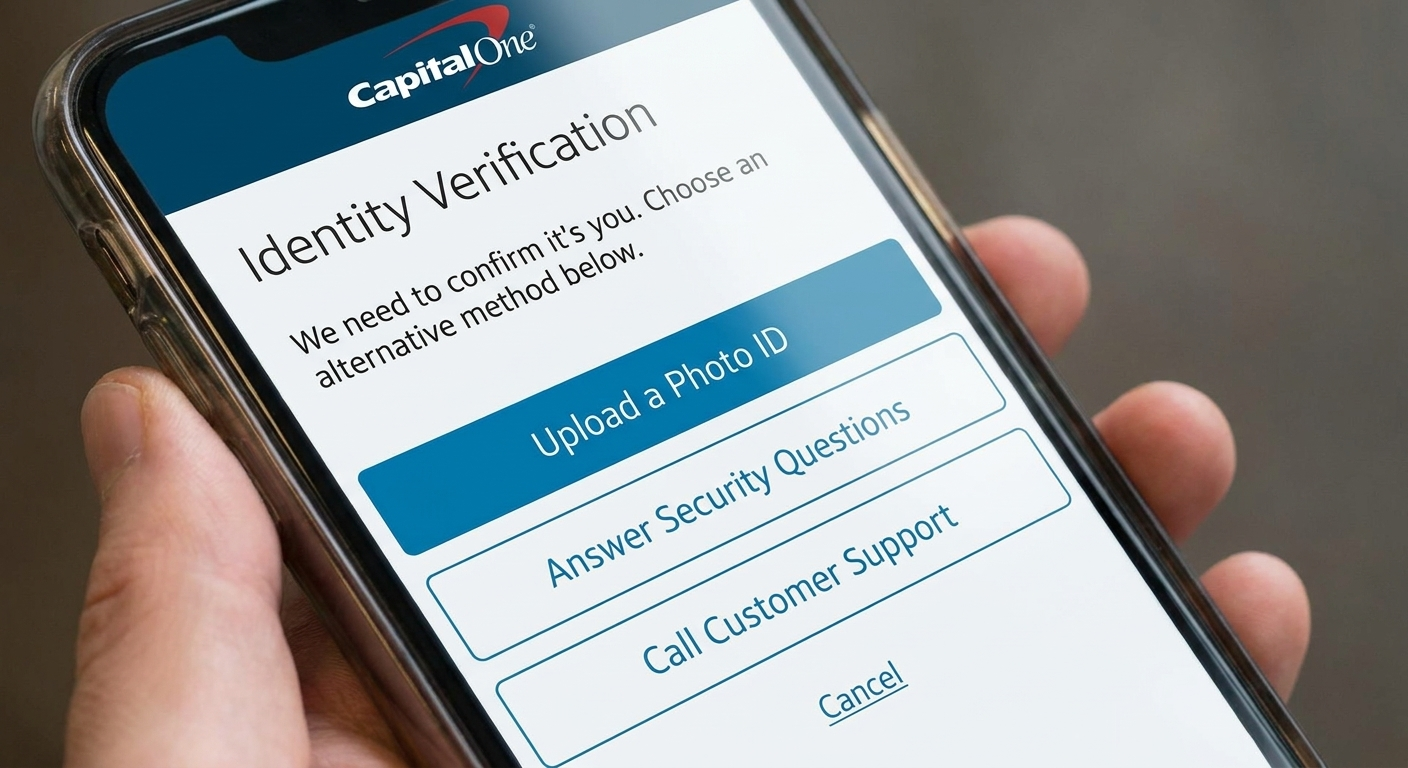
An in-branch check is the highest-assurance route the bank offers, because it requires a government-issued photo ID that no remote channel can match. Customer Support at the branch confirms who you are face to face, so it works when every digital channel is unavailable. Plan for extra time, because a branch trip is slower than a call or an app approval.
Bring these items to verify your identity without a phone:
Account security is a priority for Capital One, and the in-branch check aims to block unauthorized access through a face-to-face ID review. A branch visit removes reliance on any SMS OTP, so it ends a repeated "capital one security verification failed" loop for customers without digital alternatives.
A virtual phone number is one alternative when Capital One phone verification fails because your number itself is the problem. Travel, a carrier switch, or a "capital one phone number not eligible" error can leave you without a working number for the code. Virtual phone number services offer temporary numbers that receive an SMS in a browser dashboard.
Virtual phone numbers receive SMS codes over the internet, not through a physical SIM card. Each one is a software-based line that a virtual phone number service assigns on demand to catch a capital one verification code the same way a normal SIM does. This gives users a route to capital one SMS verification when a standard number is unavailable.
| Option | Setup time | Cost | Reusability | Privacy |
| Physical SIM card | Days by mail or a store trip | $10 to $40 or more upfront | Ongoing, tied to one carrier | Tied to your name and ID |
| Virtual number (temporary) | Under 3 minutes online | From about $0.20 per number, see current prices | Reusable in long-term rental | Personal number stays private |
Number type acts as a signal, which is where limits appear. According to third-party sources, Capital One rejects most virtual, temporary, VoIP, and rented numbers, and flags some as "capital one phone number not eligible". Third-party sources also report that the bank generally requires a US mobile number tied to a real wireless carrier. The bank has not published an official confirmation of either point, so treat both as unverified.
A legitimate virtual number service differs from a gray-area SIM-swap tool, and the distinction matters. Compliant services rent you a real number to receive a code, while a SIM-swap tool hijacks someone else's line. For a fuller breakdown, see this guide to what a virtual phone number is.
SMSFAST is a retail service that sells private temporary virtual numbers to receive SMS verification codes without a physical SIM. The service supplies a temporary phone number for capital one in a browser dashboard. It fits users who lack a suitable number, or who want to keep a real number private. People who search for a "capital one burner phone number" are usually after this privacy use case, and the correct term is a virtual number.
Follow these steps to receive a capital one SMS verification code on SMSFAST:
Get your free $0.25: subscribe to SMSFAST on Telegram and test your first number before any top-up.
SMSFAST offers two rental modes for this task. Activation mode reserves a number for a short one-time verification, while long-term rental keeps a number for a longer period and stays exclusive to you. Refund to balance applies in activation mode when no code arrives, and cancellation for long-term rental is coming soon.
If a capital one SMS verification code never lands, you cancel the activation on SMSFAST and the cost returns to your balance automatically. The service also runs 24/7 support, and multi-factor authentication enhances account security whichever number delivers the code. An SMS OTP stays one proof inside that model, so the code still protects the account. Pricing and both rental modes are listed on the SMSFAST prices page.
Updating your backup contact information is a practical step that keeps a second verification path open. Capital One requires phone verification, so a current backup number and a current email both matter. The two subsections below cover each.
A secondary phone number gives the bank a second route for capital one two step verification when your main line fails. Phone verification is a method used by Capital One, and a current backup number is your first guard against a repeat "capital one phone number not eligible" error. Update it whenever you change carriers.
Run this quick Backup Contact Info audit:
The Capital One Mobile app includes a Profile then Security path for security features, including Mobile App Verification under Additional Security. That path's exact step to add or update a backup number is not independently verified, so confirm it in the live app.
A current email address is a secondary safeguard that keeps a second verification path open on your account. When that email goes stale, SMS becomes your only remaining channel, so check the address in your Capital One profile settings today. A current email also lets the bank send recovery links and security alerts that a blocked SMS cannot deliver.
Email verification as a documented backup path is not independently verified in Capital One's public documentation, so do not rely on it as your only route. Phone verification can still have delivery issues, and an outdated email removes the fallback. That leaves the capital one login verification code by SMS as the sole channel when a capital one OTP not received event hits.
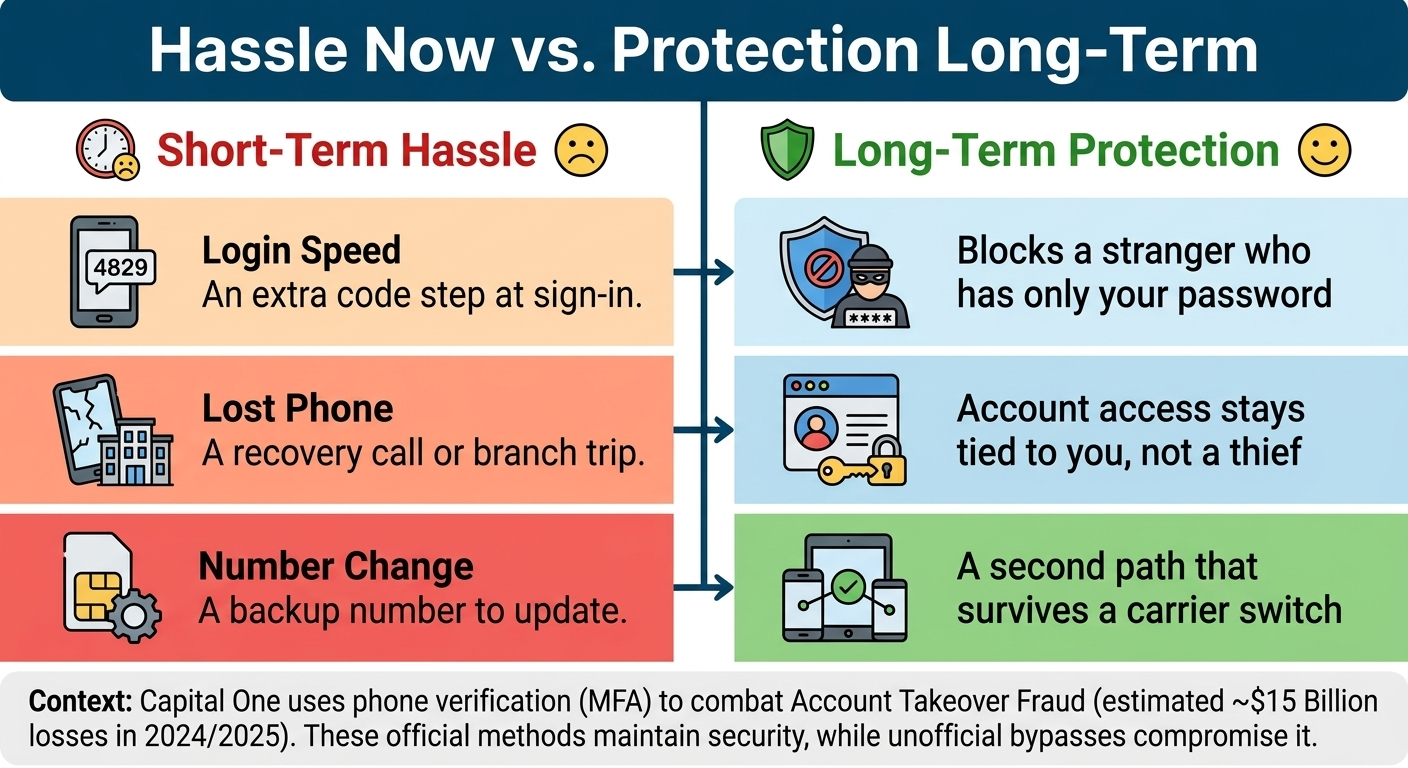
Capital One uses phone verification in 2026 because account takeover fraud remains a large, measurable threat. Account takeover fraud affected roughly 6 million US consumers in 2025, with losses reported above $15 billion. An Equifax business blog reports consumer account takeover losses of $15.6 billion in 2024. Both figures are secondary summaries, not audited filings, so treat them as estimates.
Multi-factor authentication is a security standard for Capital One that enhances account security by adding a second proof beyond the password. Capital One two step verification uses that model through an SMS code, a measure proportionate to the fraud numbers above.
Searchers who look up how to get around capital one 2FA or skip capital one phone check want access, not a weaker account. A virtual number receives the legitimate code; it does not defeat the check.
Unofficial methods that skip the check can compromise account security, such as handing your login code to a stranger. Every method here works inside the bank's intended security framework. The bank verifies identity before it shares account information, and these routes respect that rule.
See this explainer on two-factor authentication solutions and this guide to the SMS code mechanism behind each login.
Get a virtual number on SMSFAST and receive your SMS in the dashboard
You cannot bypass Capital One phone verification, because the SMS one-time code confirms account ownership. Use an official route instead: a Customer Support call, a Mobile app approval, or in-branch identity verification. A compliant virtual number can receive the code when your own number fails.
When a Capital One verification code does not arrive, the SMS OTP likely hit a delivery issue. Request a new code, confirm your number is active, or approve a push in the Mobile app. Customer Support can verify your identity and escalate when the code still will not reach you.
Capital One verifies identity without your usual phone through three routes: Customer Support, a Mobile app push, or a branch visit with a government-issued photo ID. Agents confirm information on file before restoring access. A branch visit is the highest-assurance route when digital channels fail.
Capital One keeps asking for verification because two step verification runs at login and before sensitive transactions. The bank pairs your password with a second proof, an SMS code, to block unauthorized access. Frequent prompts often signal a new device, a new location, or a larger-than-usual transaction.
Without your phone, Capital One offers three official alternatives: a Customer Support call, an in-app push in the Mobile app, and in-person verification at a branch or cafe using a QR code. Each route confirms your identity first. A branch visit clears a repeated verification failure fully.
A virtual or temporary phone number can receive a Capital One SMS code, but the bank rejects most virtual, VoIP, and rented numbers by third-party accounts. The bank reportedly favors a US carrier number. SMSFAST supplies US virtual numbers, with refund to balance in activation mode if no code arrives.
You cannot skip verifying your phone number on Capital One, since phone verification confirms account ownership. Use an official recovery channel or a compliant virtual number to complete the check. Keeping a backup phone number and a current email on file reduces future lockouts.
Cash App allows one verified account per SSN, not per phone or email. See the real rules, the legitimate business-account path, and what happens if you break policy.
SMS or email verification code missing? See the exact fixes for iPhone, Android, WhatsApp, Telegram, Google, and 10+ other platforms, including VPN and regional blocks.