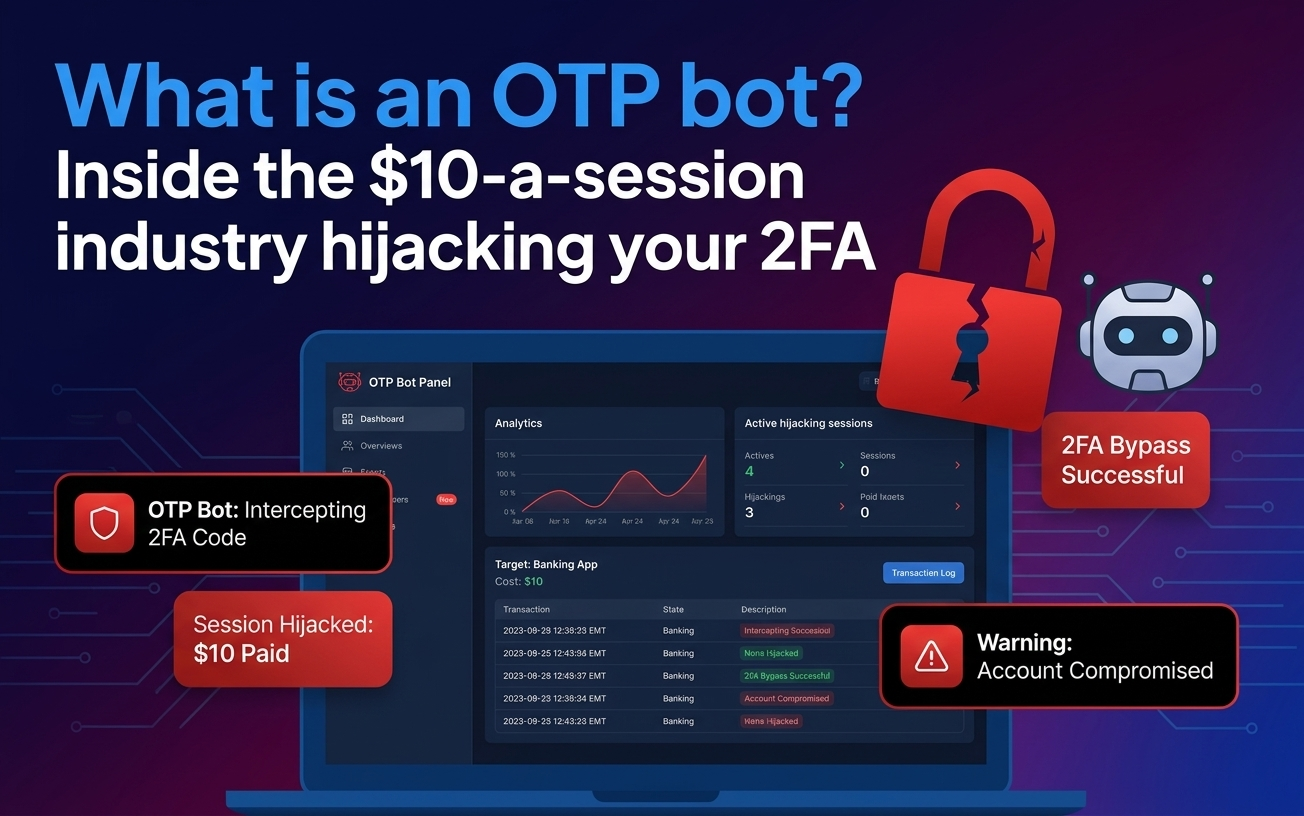
OTP bot rentals cost $10 to $50 per attack session on Telegram and dark web forums (CybelAngel, 2025).
OTP bot attacks begin after credential theft, so credential hygiene decides exposure.
SMS-based 2FA is vulnerable by architecture, because it authenticates channel access rather than a phishing-resistant identity.
Phishing-resistant MFA (such as FIDO2, passkeys, and PIV smart cards) is the only categorical fix for OTP interception.
Rate limiting and shortened OTP windows are transitional controls, not permanent solutions.
An OTP bot is an automated fraud tool that intercepts one-time passwords in real time to complete account takeover. In a representative fraud pattern, a victim answers a call that appears to come from a bank security team. The victim reads back a verification code, and the balance is gone within minutes.
OTP bots turn this sequence into an industrialized criminal market. OTP bot rentals cost $10 to $50 per attack session on Telegram and dark web forums (CybelAngel, 2025). Each OTP bot exploits two-factor authentication (2FA) by capturing the second factor as the user submits it. Attackers sell OTP bots as crimeware as a service.
Understanding two-factor authentication (2FA) and OTPs: the fundamentals
Two-factor authentication (2FA) verifies identity with two separate proofs, and one-time passwords are a widely used second proof. See Two Factor Authentication Solutions for the fundamentals.
The three factors of authentication
Authentication uses three factor categories, defined by Microsoft and NIST: something you know, something you have, and something you are. A password is something you know. A biometric is something you are. A one-time password (OTP) counts as something you have only when it binds to a device, token, or authenticator app (NIST CSRC glossary).
Factor category
Meaning
OTP example
Something you know
A secret the user recalls
A memorized backup code
Something you have
A possession the user holds
An OTP tied to a phone or authenticator
Something you are
A physical trait
Biometric check releasing a stored OTP
Why OTPs became the default second factor
One-time passwords became the default second factor for two verified reasons: low implementation cost and near-universal device access. SMS, email, and push OTPs cost far less to deploy than hardware tokens. OTPs also ran on widely available phones without extra setup. This ubiquity is why OTP bot exploitation scaled so fast.
OTP bot meaning: breaking down what these tools actually are
An OTP bot is automated software that captures a live one-time password. It relays that code to an attacker before the code expires.
What is a OTP bot, technically speaking?
An OTP bot is a type of internet bot that harvests one-time passwords inside 2FA and MFA flows. It works through deception, not by breaking cryptography. Think of an OTP bot as an automated scam call center that imitates a trusted organization at scale.
Telegram is a widely described deployment and command channel for these bots (Krebs on Security, 2021). The OTP bot uses social engineering, so it exploits human trust.
What's an OTP bot used for: the attacker's end goal
Attackers deploy OTP bots to enable account takeover across high-value platforms. Common target industries include banking and e-commerce (Radware), plus cryptocurrency exchanges (CybelAngel, 2025). Once a security hacker combines valid credentials with a live OTP, the attacker gains full authenticated access. For a business, account takeover results in financial loss and data compromise.
How does an OTP bot work? The anatomy of an attack
An OTP bot is the final step of an attack, not the entry point. To bypass two-factor authentication, every OTP bot attack starts with already-compromised credentials.
Step one: credentials come first
Before an OTP bot runs, attackers already hold the victim's username and password. They obtain credentials from breached databases, infostealer malware, phishing, credential stuffing, or dark web purchases (CybelAngel, 2025). Phishing attempts to steal credentials by impersonating a trusted sender. Organizations cannot stop OTP bot attacks without fixing credential hygiene first.
Step two: triggering and intercepting the code
The interception runs live, and a full OTP bot attack follows five steps inside the OTP's short validity window (Authgear):
The security hacker submits stolen credentials, which triggers a genuine one-time password.
The OTP bot calls or texts the victim from a spoofed phone number.
The bot imitates a trusted organization and applies urgency.
The victim speaks or keys the code into a fraudulent IVR menu.
The bot relays the OTP, and the attacker logs in before expiry.
Documented cases show real-time execution on a live call (Krebs, 2021). OTP expiry varies by service.
Types of OTP bots and OTP bypass bot tactics you'll encounter
OTP bots are also called account takeover bots or 2FA bypass bots. All three variants run the same social engineering mechanism.
Voice bots: automated calls with urgency scripts and IVR-style menus that capture spoken or keyed codes.
SMS OTP bots: spoofed sender IDs and smishing messages that imitate legitimate security alerts.
App-based bots: fake interfaces and manipulation flows that target authenticator app users.
Voice bots and automated call scripts
Voice OTP bots use automated call scripts, urgency prompts, and IVR-style menus (Recorded Future, 2021). Press-1 options and DTMF digit capture extract the codes. AI-generated voice prompts also appear, and one operator can run many calls at once.
SMS OTP bot attacks and spoofed messaging
SMS OTP bots use spoofed sender IDs and fraudulent messages that imitate legitimate security alerts to redirect codes. Smishing links are a widely documented technique in these ecosystems. These methods appear broadly, though not every SMS OTP bot uses both. See SMS OTP as a distinct vector.
App-based and social media OTP bypass bot variants
App-based OTP bypass bots target authenticator app users by abusing application-level weaknesses or tricking users into fake interfaces. Social engineering scripts use impersonation to raise credibility. Specific sync-prompt tricks and scraped social data remain unconfirmed as documented OTP bot mechanisms.
Why SMS OTP bot attacks exploit the weakest link in your stack
SMS-based two-factor authentication is the weakest common link in the authentication stack. It protects a communication channel, not a phishing-resistant identity.
The architectural flaw: same channel, different intent
SMS-based 2FA authenticates access to a communication channel, not a phishing-resistant authenticator. This exposes it to interception, SIM swap attack, SS7 exploitation, and number-porting fraud (OWASP MFA Cheat Sheet). A SIM swap attack hijacks the phone number and bypasses SMS-based 2FA. Security guidance discourages SMS as a second factor (WorkOS).
The weakness is architectural, so user vigilance alone cannot close it. See what an SMS code is.
How AI voice cloning is making this worse
AI voice cloning raises the credibility of OTP bot calls that trick users into revealing SMS one-time passwords. Research shows people cannot reliably distinguish cloned AI voices from real ones (Barrington et al., Scientific Reports, 2025). The FTC warns scammers use voice cloning to make fraudulent requests more believable (FTC, 2023). Over the next 12 to 18 months, synthetic voice will likely make impersonation harder to detect.
How to detect and stop the best OTP bot attacks in 2026
The strongest defense against OTP bot attacks in 2026 is phishing-resistant MFA. It removes the OTP interception that behavioral detection and dark web monitoring only reduce.
Raised failed-login-to-OTP ratios flag automated abuse.
FIDO2 security keys and passkeys are phishing-resistant methods that structurally remove OTP interception risk. They use public-key cryptography with origin and domain binding, so the authenticator responds only to the legitimate domain (FIDO Alliance). OTP methods stay vulnerable to interception and relay, which domain-bound passkeys prevent (FIDO Alliance, 2022).
Certificate-based PIV and smart-card authentication is also phishing-resistant. Real deployment carries cost, device logistics, and training. These are implementation challenges, not reasons to avoid the technology.
Behavioral detection signals worth alerting on
Behavioral anomaly detection separates OTP bot activity from normal users through log-based heuristics. High failed-login-to-OTP ratios, burst-then-success patterns, device and IP telemetry mismatches, and impossible-travel indicators all signal automated account takeover (Sensfrx). Security guidance frames these as alerting heuristics, not standalone proof of compromise (Authgear). Analysts treat them as triggers for review.
Dark web monitoring as an early warning system
Dark web monitoring tracks credential-leak forums and Telegram bot-service channels in near real time. Vendors state these alerts can notify defenders before stolen credentials are used, which enables earlier password resets (CloudSEK, 2024). A direct link to imminent OTP bot attacks is plausible but not established. Security teams also pair this with a virtual phone number strategy for lower-risk registrations.
Building long-term resilience: best practices beyond the basics
Long-term resilience against OTP bots stacks three complementary layers: awareness, compensating controls, and access controls. Each layer assumes the others, and no single layer suffices alone.
Employee and customer awareness that actually works
Effective awareness programs teach recognition of the exact scripts OTP bots use, not generic caution. They train employees and customers to identify the specific phrases and pressure tactics of social engineering. Compliance-only training rarely shifts behavior, while script-specific recognition is more likely to. Simple incident-reporting processes complete the layer.
Compensating controls while you migrate off SMS
Rate limiting, shortened OTP windows, and out-of-band verification reduce OTP bot effectiveness without removing it. Throttling caps OTP request volume and abuse (OWASP Bot Management Cheat Sheet). Recommended OTP expiry commonly falls between 2 and 5 minutes for login and 2FA cases (Arkesel, 2026).
These are transitional controls, not permanent solutions. Organizations that stop here stay materially exposed.
Access controls and threat intelligence as force multipliers
The principle of least privilege and role-based access control (RBAC) limit users to minimum necessary permissions. This reduces exposure after account compromise (Huntress).
Tightened access control contains the blast radius even after a successful OTP bot attack on one account. It blocks lateral movement and privilege escalation. SIEM-integrated monitoring adds a detection layer for authentication events broadly.
Frequently Asked Questions
What is an OTP bot?
An OTP bot is automated software that intercepts one-time passwords in 2FA flows. It relays them to attackers in real time. An OTP bot enables account takeover by capturing the second factor through deception, not by breaking cryptography. Rentals cost $10 to $50 per session (CybelAngel, 2025).
How do OTP bots work?
OTP bots work after credential theft, then trigger a genuine one-time password. The bot calls or texts the victim while impersonating a trusted organization. The victim reveals the code, and the bot relays it before expiry. The full sequence runs live across five steps.
Can an OTP bot bypass SMS-based 2FA?
An OTP bot can bypass SMS-based 2FA. SMS authenticates channel access, not a phishing-resistant identity. Four channel attacks defeat SMS codes: SIM swap, SS7 exploitation, number porting, and interception (OWASP). Phishing-resistant MFA such as FIDO2 removes this exposure through domain binding.
What security risks do OTP bots pose?
OTP bots pose account takeover risk across banking, e-commerce, and cryptocurrency platforms (Radware; CybelAngel, 2025). Successful takeover results in financial loss, data compromise, and identity theft. Crimeware-as-a-service pricing of $10 to $50 per session lowers the barrier to entry for attackers.
How can organizations detect OTP bot activity?
Organizations detect OTP bot activity through four behavioral signals: raised failed-login-to-OTP ratios, burst-then-success patterns, device and IP telemetry mismatches, and impossible-travel indicators (Sensfrx). Security guidance treats these as alerting heuristics, not standalone proof, so analysts confirm them first.
What are the types of OTP bots?
OTP bots fall into three types: voice bots using automated call scripts and IVR menus, SMS OTP bots using spoofed sender IDs and smishing, and app-based bots targeting authenticator app users. All three run the same social engineering mechanism at different scales.
How can businesses protect themselves from OTP bots?
Businesses protect themselves by deploying phishing-resistant MFA such as FIDO2 security keys and passkeys. These use domain-bound public-key cryptography (FIDO Alliance). Supporting layers include behavioral detection, dark web monitoring, least-privilege access, and awareness training. Rate limiting and 2-to-5-minute OTP windows are transitional only.
An SMS code is a short numeric one-time password sent by text to verify your identity. Learn how it works, where it's used, its security risks, and safer alternatives.
OTP bots are automated tools sold on Telegram for $10-$50 per session that intercept your 2FA codes in real time. Learn how they work, which industries they target, and how to stop them.