You can create and use a ChatGPT account without a phone number in 2026. OpenAI dropped phone verification for standard sign-up and everyday chat, and a number returns in only two places: your first API key and Codex in the desktop app. The four methods below each reach the chatbot without your personal line, and each one carries an honest limit.
Do you need a phone number for ChatGPT? The straight answer
ChatGPT no longer asks for a phone number to open an account or to chat day to day. Email verification sends a confirmation code to your inbox instead of an SMS code to a SIM.
Key takeaways
A virtual mobile number receives the SMS code when OpenAI insists on verification, with results that depend on region and carrier.
A trusted contact's mobile number covers a single sign-up, capped at three first-API-key verifications per number.
Microsoft Copilot and Google Gemini offer capable AI chat with no dedicated ChatGPT phone step.
Business VoIP lines from RingCentral or Nextiva stay blocked, because OpenAI rejects VoIP numbers.
Safety verdict: a mobile number handed to OpenAI carries low direct risk, since it serves verification and never appears in public.
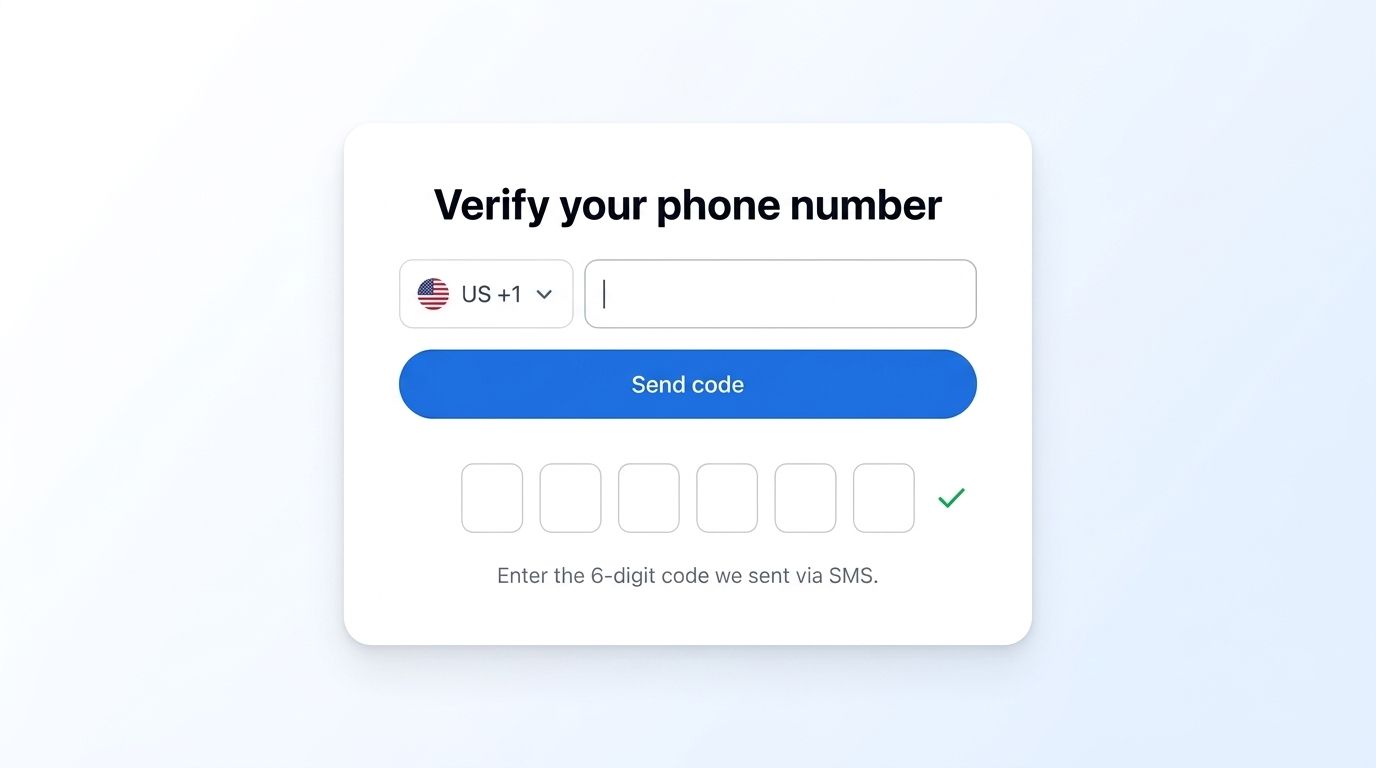
Two exceptions bring a phone number back. OpenAI mandates phone verification on platform.openai.com when you generate your first API key, though not for later keys, and the desktop app may ask for it when you open Codex. Verification codes arrive by SMS, or by WhatsApp where OpenAI offers it, and never by email or phone call.
One regional exception matters. OpenAI runs a phone-only signup beta where the phone number is the signup credential itself, mostly across thirteen regions: the United States, the Netherlands, France, Spain, the United Kingdom, Poland, Germany, Japan, India, Pakistan, Algeria, Uzbekistan, and Ukraine. No other regions are planned. A paid ChatGPT Plus subscription changes none of this, because the phone rules track account creation and API access, not the plan tier.
For an everyday ChatGPT account outside that beta, an email address settles the whole sign-up.
Why does OpenAI ask for your phone number?
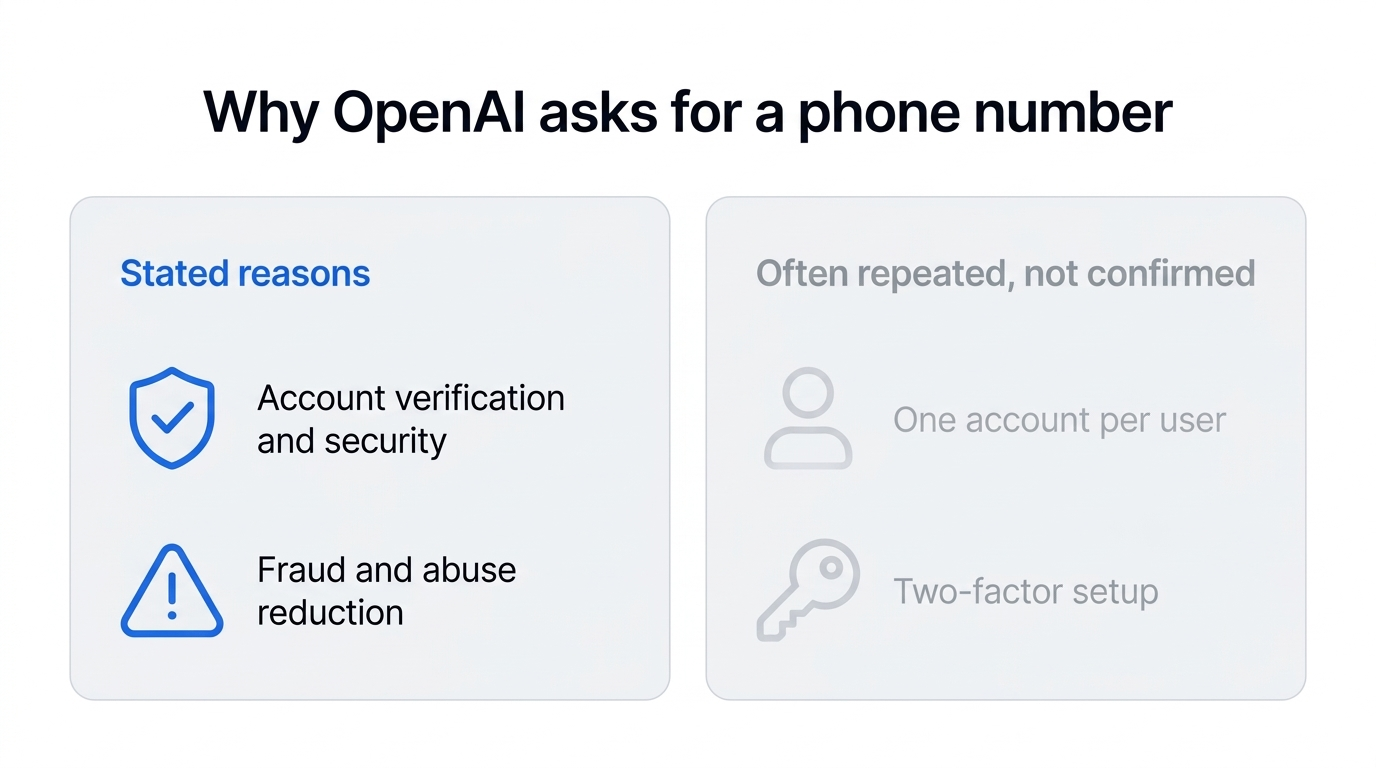
OpenAI asks for a mobile number to confirm the account and to cut fraud and automated abuse. The request appears at two documented moments, not across the whole product. Two reasons sit behind it:
Account verification and security. OpenAI ties first API key generation to a verified mobile number to confirm that a real person holds the account, per its Help Center.
Fraud and abuse reduction. OpenAI blocks number types it links to higher fraud, which is why landlines, VoIP, Google Voice, and premium numbers fail verification.
GPT-4 explains the tighter guard. The paid OpenAI API runs on GPT-4 and OpenAI's newer models, all reached through one key. OpenAI guards that high-value service more carefully than a free chat window, so API key creation adds a verification step that casual ChatGPT use skips.
Third-party guides also cite one-account-per-user enforcement and two-factor setup. OpenAI does not list those as stated causes, so weigh them as likely rather than confirmed.
Is it safe to give ChatGPT your phone number?
Handing OpenAI a mobile number carries low direct risk, with two caveats worth weighing. OpenAI processes personal data under its Privacy Policy and runs privacy requests through its privacy portal, so the data path follows a published standard.
One caveat outweighs the rest: OpenAI does not let you change or unlink a number once you add it. Pick a line you keep, not a one-off you lose next month. People who verified with an old number now sit locked out of Codex.
A practical caveat follows. Shared devices and geo-restricted regions raise the odds of a flagged check. Other assistants such as Microsoft Copilot and Google Gemini also run account-level verification, so a number-free preference reads as mainstream rather than suspicious.
Methods to use ChatGPT without a phone number
Four methods reach ChatGPT without your personal number. Each one fits a different need, and each carries an honest limit. The virtual-number route comes first, then the lower-effort options, and finally the business-VoIP reference for teams.
Common reasons people seek these methods
Privacy sits at the top. A new ChatGPT account that never touches your real number keeps that number off one more company's database. Multi-account work ranks second, since freelancers, agencies, and testers often run separate OpenAI accounts for separate client projects.
Geographic access comes third, because OpenAI does not support ChatGPT in every country, and SMS codes stall where the service sits unavailable. Agency and team account management counts as a legitimate professional use case, and this guide treats it as one.
Method 1: using a virtual or temporary phone number
A virtual mobile number catches the SMS code in the two cases where OpenAI insists on verification: first API key generation and Codex. OpenAI accepts mobile numbers over SMS and rejects landlines, VoIP, and Google Voice, so the number type decides the result. A private number from SMSFAST receives that code in the dashboard with no physical SIM.
Honest limits apply. The code does not always arrive, shared free numbers turn unstable, and short-lived numbers expire. A mobile-tagged line clears OpenAI's carrier check more often than a generic VoIP line, though the outcome depends on region and carrier.
What exactly is a virtual or DID number?
A virtual number is a cloud-based phone number, also called a DID (Direct Inward Dialing) number, that receives SMS messages online without a physical SIM card. Picture a private mailbox assigned to catch one text. OpenAI blocks generic VoIP lines, so a mobile-tagged virtual number matters here, because it clears the carrier check that a standard VoIP line fails.
Method 2: using a trusted contact's number
A trusted contact's mobile number verifies one ChatGPT sign-up at no cost. Ask someone who will share the one-time code, enter their number, and type the SMS code back. OpenAI caps a single number at three first-API-key verifications, and a fourth account on that number stays blocked. This route suits a single quick sign-up, not a professional workflow that needs many accounts.
Method 3: reaching GPT-level tools through other platforms
Microsoft Copilot, formerly Bing Chat, carries no Copilot-specific phone step. Any phone prompt you meet comes from the underlying Microsoft, Apple, or Google account sign-in, not from Copilot itself. Google Gemini, formerly Google Bard, may still ask for phone verification through the standard Google account flow.
ChatGPT also runs inside WhatsApp in the European Economic Area, where you message the verified 1-800-ChatGPT contact with no account. The 1-800-ChatGPT hotline answers an ordinary phone call too, and US and Canada numbers get 30 free minutes per month. WhatsApp availability has moved by region during 2026, so check the Help Center before you lean on it.
Method 4: business VoIP numbers for long-term use
RingCentral and Nextiva sell business VoIP phone systems, not ChatGPT verification tools. OpenAI rejects VoIP numbers at the verification screen, so a RingCentral or Nextiva line does not pass the OpenAI SMS check. Teams weighing a permanent number sometimes compare the cost, around $15 per user each month for Nextiva and about $20 for RingCentral on annual billing as of 2026, against a low-cost temporary number. Treat these services as a cost reference for an organisation, not a verification workaround.
Step-by-step: how to get your OpenAI code with a virtual number
This walkthrough covers the case where OpenAI asks for a number, first API key generation or Codex, with a private number from SMSFAST. A standard ChatGPT account needs none of these steps.
Reach the OpenAI screen that asks for phone verification, on platform.openai.com or in the desktop app.
Open SMSFAST and select OpenAI as the target service.
Pick a mobile number from a supported country. US and European numbers tend to clear OpenAI's checks.
Enter that number on the OpenAI verification screen and request the code.
Watch the SMSFAST dashboard. The SMS code appears in seconds, and you type it back into OpenAI.
If OpenAI rejects the number, pick a fresh number from a different supported country and repeat from step 3.
Common roadblocks and quick fixes
A number-based verification fails for three documented reasons, and each one has a clean fix:
OpenAI rejects the number. Use a mobile-tagged number over SMS, since landlines, VoIP, and Google Voice do not pass.
OpenAI says the number was used too many times. OpenAI caps first-API-key verification at three uses per number, and a deleted account frees the number only after 30 days. Pick a fresh mobile number.
The SMS code never arrives. Confirm the region sits on OpenAI's supported list, then choose a number from a supported country.
Geo-restrictions: why SMS codes may not arrive
OpenAI does not support ChatGPT and the API in every country, and access from an unsupported location can lead to account blocking or suspension Codes stall or never arrive where the service sits unavailable. The reliable fix picks a private number registered in a fully supported country rather than retrying a blocked one.
Risks and limits worth knowing
Three risks sit on the record, and honesty about them beats pretending they do not exist:
OpenAI rejects VoIP-type numbers at the verification screen, so the wrong number type fails outright.
OpenAI caps each number at three first-API-key verifications, which limits reuse across accounts.
Access from an unsupported country can trigger account blocking or suspension.
No confirmed OpenAI rule bans virtual numbers for ChatGPT outright, so treat any claim of a specific Terms of Service violation as unverified. Risk tolerance tracks the user. A privacy-minded individual verifying one account carries low exposure. Teams running many accounts across restricted regions face a higher suspension risk, where a stable, mobile-tagged number matters more.
Compare your virtual number options for ChatGPT
A private virtual mobile number wins for the cases where OpenAI asks for a code, while free and VoIP options fall short. The table weighs the realistic choices for a temporary phone number.
Option
ChatGPT verification
Approx. cost
Number type
Suited to
Private virtual number (SMSFAST)
Often works for SMS codes
Low per-number fee
Mobile-tagged
First API key or Codex
Trusted contact's mobile
Works, 3-use cap
Free
Mobile
A single quick sign-up
Free or shared public number
Unreliable
Free
Mixed
Low-stakes throwaway tests
Business VoIP (RingCentral, Nextiva)
Rejected, VoIP blocked
About $15+ per user monthly
VoIP
A team phone system
OpenAI rejects landlines, VoIP, and Google Voice, so a number's type and region decide the result. Confirm current status on OpenAI's Help Center.
Which method is right for the use case
Match the method to the job, not the other way round. A privacy-minded individual who only wants to keep a personal number private should lean on a mobile-tagged virtual number for any sign-up that asks for a code, and skip the free public pools that leak and fail.
A developer generating a first API key needs one clean mobile number that passes OpenAI's carrier check, and should keep it rather than burn it, because OpenAI will not unlink it later. Teams that run many accounts should budget for stable numbers, track the three-use cap per number, and avoid business VoIP lines that OpenAI rejects.
OpenAI has tightened verification on API and developer surfaces through 2026 while easing it elsewhere. Expect that split to hold, and choose a number you keep over a throwaway you lose.
$0.25 Gift!
Subscribe to our Telegram channel and receive $0.25 on your balance.
Frequently Asked Questions
Can I use ChatGPT without a phone number?
Yes. OpenAI dropped phone verification for account creation and everyday use, so an email address or a Google, Microsoft, or Apple login finishes sign-up. A mobile number returns only for your first API key and for Codex in the desktop app.
Why does ChatGPT require a phone number?
ChatGPT itself does not. OpenAI asks for a mobile number at first API key generation to confirm the account and cut fraud. Landlines, VoIP, and Google Voice fail that check, while mobile numbers over SMS pass.
How do I use a virtual number for ChatGPT?
Pick a private mobile number from SMSFAST, select OpenAI as the service, and enter it when OpenAI asks. The SMS code appears in your dashboard in seconds. OpenAI caps each number at three first-API-key verifications.
Is it safe to put your phone number on ChatGPT?
The direct risk stays low. OpenAI processes the number under its Privacy Policy, yet it does not let you change or unlink a number later. Pick one you keep, and move two-factor to an authenticator app.
What are the risks of using a virtual phone number for ChatGPT?
Three risks stand out: OpenAI rejects VoIP-type numbers, caps each number at three first-API-key verifications, and can block accounts opened from unsupported countries. No confirmed OpenAI rule bans virtual numbers outright.