A fintech team scaled from 5,000 to 80,000 monthly signups and watched its verification bill triple, because the "cheap" per-message quote hid a separate platform fee on every code. That surprise is the reason this guide exists.
An OTP service provider is a verification vendor that delivers one-time passwords to confirm a user owns a phone number before a business grants access. Multi-factor authentication, business verification, and fraud control set the stakes for every choice below.
This buyer's guide ranks 8 OTP service providers, breaks down how OTP pricing actually works, and gives a testing framework you can run before signing. Each provider is treated as one option among several, judged on the same criteria.
Key takeaways
Three findings decide most OTP provider choices: channel breadth, cost model, and delivery reliability.
Top three by fit: Twilio Verify wins on channel breadth, Plivo Verify on cost, and Infobip on global scale, so the right pick depends on volume and geography.
A common pricing trap: a low per-message rate often excludes a separate per-verification platform fee, which can add about $500 per 10,000 codes on Twilio Verify rates.
An often-overlooked criterion: per-carrier delivery benchmarking and multi-channel fallback matter more than headline price, because a failed code is lost revenue.
Top OTP service providers for business in 2026
The eight OTP service providers below cover most business verification needs, from a two-person startup to a multinational bank. No single vendor is the best SMS gateway for OTP across every use case, so the table reads as a structured comparison, not a fixed ranking. Each OTP service provider uses an SMS gateway paired with a verification API, and the columns map those capabilities before the detailed reviews.
Provider
Pricing model
Channels supported
Global coverage
Best for
Twilio Verify
$0.05 per verification plus channel fees
SMS, WhatsApp, Voice, Email, Push, SNA, TOTP
Broad, 190+ countries
Enterprises needing every channel
Plivo Verify
$0.00 verification, pay channels only
SMS, Voice, WhatsApp
Broad global routing
Cost-conscious growth teams
Vonage Verify
Pay per successful conversion plus channel use
SMS, Voice, WhatsApp, Email, Silent Auth
Broad, multi-channel
Conversion-sensitive flows
Infobip
Quote-based, volume tiers
SMS, WhatsApp, Voice
Global, high-volume routes
Large multinational rollouts
MSG91
Per-credit, per-message, India-specific
SMS, multi-channel OTP
Strong in India
India-focused deployments
Sinch
Carrier-grade, quote-based
SMS, Voice, FlashCall
Tier-1 carrier routes
Delivery-reliability priority
Telesign
Identity intelligence plus messaging
SMS, Voice
Broad, fraud-scored
Fraud-sensitive platforms
Firebase Authentication
Phone auth priced per SMS, some free tiers
SMS phone auth
Mobile SDK reach
Mobile-first early teams
Twilio Verify: the enterprise-grade all-rounder
Twilio Verify supports the widest channel set in this shortlist: SMS, WhatsApp, Voice, Email, Push, Silent Network Authentication, and TOTP. The vendor charges $0.05 per successful verification plus $0.0083 per SMS in the United States. TOTP is a type of one-time password, and Google Authenticator generates it for offline login. The legacy Authy API is closed to new customers, so Twilio Verify is the recommended product for new builds.
Strengths: Twilio Verify covers seven channels, including Silent Network Authentication and TOTP, through one API.
Weaknesses: the $0.05 per-verification platform fee compounds quickly at high volume.
Best for: enterprises that need channel breadth and regulatory-grade tooling in one provider.
Plivo Verify: the value pick for growing businesses
Plivo Verify charges $0.00 per verification and bills only for the SMS, Voice, or WhatsApp channel used, with AI-driven Fraud Shield included at no extra cost. That zero-fee model contrasts directly with Twilio Verify, where the platform adds $0.05 to every successful verification. Plivo documentation describes a minimum monthly commitment for Verify, so a very small sender should confirm that floor first.
Strengths: Plivo Verify removes the per-verification fee and folds fraud scoring into the base channel price.
Weaknesses: the vendor carries a documented minimum monthly commitment and thinner enterprise features than larger rivals.
Best for: growing businesses that route high SMS OTP volume and want to pay only for delivery.
Vonage Verify: strong multi-channel failover
Vonage Verify suits businesses where verification completion rate drives revenue, because automated fallback moves a user across channels until one code lands. The default model, Vonage Verify Conversion, charges a platform fee only on successful conversions, with channel fees billed by usage. Verify V2 sequences fallback by workflow, for example Silent Authentication, then SMS, then Voice.
Strengths: Vonage Verify charges its platform fee only on successful conversions and configures fallback by workflow.
Weaknesses: the conversion model needs modeling against your funnel to predict the effective per-user cost.
Best for: flows where a completed verification is worth far more than the message that carried it.
Infobip: the enterprise choice for global scale
Infobip processes more than 1.2 billion transactions per day across global routes, which fits large multinational rollouts. Infobip Signals uses machine learning to block fraudulent OTP traffic in real time, before a charge is billed, which protects high-volume SMS senders from artificial inflation. Quote-based pricing adds procurement friction for a small buyer, so Infobip reads best for enterprises with dedicated vendor management.
Strengths: Infobip pairs 1.2 billion daily transactions with real-time, machine-learning fraud blocking through Infobip Signals.
Weaknesses: quote-only pricing slows evaluation for small teams without procurement resources.
Best for: multinational businesses running SMS OTP at scale with a vendor-management function.
MSG91: a practical OTP service provider for India
MSG91 suits India-focused deployments, because it publishes India pricing pages and country-specific per-message rates. This OTP service provider offers an OTP verification service through its SendOTP flow for authentication. MSG91's documented pricing advantage is India-specific and does not extend across Southeast Asia. Indonesian terms such as jasa otp online and jasa otp murah reflect general market demand, not MSG91 coverage there.
Strengths: MSG91 documents transparent India rates and a purpose-built SendOTP verification flow.
Weaknesses: MSG91 coverage of Western markets is thinner than global CPaaS rivals.
Best for: businesses whose verification volume concentrates in India.
Sinch: telecom-grade reliability for regulated industries
For businesses that prioritize the code arriving, Sinch pairs deep carrier relationships with FlashCall verification. FlashCall places a missed call where the incoming Caller ID serves as the code, captured automatically on Android, while iOS users may enter it manually. Sinch positions its infrastructure as carrier-grade and tier-1. That carrier-grade routing points to reliability for delivery-sensitive, regulated traffic.
Strengths: Sinch offers FlashCall verification and tier-1 carrier routing for delivery-sensitive traffic.
Weaknesses: FlashCall behavior differs across Android and iOS, which affects a uniform user experience.
Best for: businesses that rank delivery reliability above channel breadth.
Telesign: built for fraud-sensitive platforms
Telesign scores a phone number before a message sends, which suits platforms where fraudulent account creation threatens revenue. Its Telesign Intelligence product returns numeric risk scores, reason codes, and block, flag, or allow recommendations. PhoneID rates risk per number for fraud prevention, drawing on carrier data and machine learning. This identity verification service uses the one-time password as one signal, not a bare SMS gateway.
Strengths: Telesign adds phone-reputation scoring and reason codes before a code ever sends.
Weaknesses: the identity-intelligence layer adds cost that low-risk consumer apps may not need.
Best for: marketplaces, fintech, and platforms where fake accounts carry direct financial risk.
Firebase Authentication: fast setup for mobile-first teams
Early-stage mobile teams reach a first launch quickly with Firebase Authentication, because SDK integration is simple. Firebase Authentication uses reCAPTCHA when device verification is unavailable, and applies Play Integrity device attestation on supported Android devices. Phone authentication is priced per SMS and is not fully free, though some sign-in methods carry a free tier. Its fraud tooling rests on reCAPTCHA rather than OTP-specific risk scoring, so it reads as an MVP ceiling.
Strengths: Firebase Authentication ships fast, with free-tier sign-in methods and native mobile SDKs.
Weaknesses: phone-auth fraud protection leans on reCAPTCHA, not code-grade risk scoring.
Best for: mobile-first teams shipping an MVP or early-growth product, not high-value transaction flows.
OTP service providers by region: choosing for global versus local needs
Regional routing quality, not brand recognition, decides the best OTP service provider for a given market. A globally known CPaaS platform is not always the optimal local choice, because carrier filtering, route quality, and price vary sharply by country.
India shows how routing quality outweighs brand recognition. Direct tier-1 and operator routes there deliver OTP in roughly 2 to 5 seconds, against 10 to 30 seconds or more for aggregated routes. SMS OTP prices in India run roughly 0.10 to 0.45 rupees per OTP depending on route and markup. A mobile network operator provides the local SMS infrastructure that a direct route uses to skip aggregated paths.
For Latin America, Southeast Asia, Africa, and the Middle East, regional variation is a recognized industry consideration, so verify routes market by market. Requirements such as TRAI registration in India or local data laws add a compliance layer to any international otp service weighing entry. Indonesian demand shows up in searches like jasa otp wa, jasa otp online, and jasa otp whatsapp, which signal an active local market for SMS and messaging verification alike.
Regional A2P specialists such as 2Factor in India and MessageBird for WhatsApp Business API extend the shortlist where a local route beats a global one.
India and regulated South Asia: favor a direct tier-1 route provider such as MSG91 or a global vendor with confirmed local routing.
Latin America and Southeast Asia: evaluate WhatsApp-capable OTP services alongside SMS, given strong messaging adoption reflected in searches like jasa otp wa and jasa otp whatsapp.
Europe and North America: prioritize a compliance-strong vendor with SOC 2 posture and broad carrier coverage.
What is an OTP service and why does it matter for your business?
An OTP service uses a single-use, time-limited code, and a business requires these OTP services to authenticate a user or a transaction. When a customer signs in to online banking or approves a financial transaction, the one-time password is used for user authentication, and the provider delivers that code.
OTP services lower the risk of unauthorized access and credential reuse, which supports fraud control across financial transactions and account login. Multi-factor authentication includes the one-time password as one factor, layered with a password, a biometric, or a push approval, and a digital wallet or online marketplace applies the same pattern.
Identity platforms such as Okta, Inc. build OTP into MFA and single sign-on (SSO) systems, while passwordless WebAuthn offers an alternative and social login can be secured with a one-time password. Regulatory compliance frameworks such as GDPR and HIPAA apply in context, relevant to banking and healthcare rather than every OTP service.
What is an OTP provider versus a generic SMS API?
An OTP service provider provides fraud prevention before sending, routing optimization during delivery, and conversion visibility after delivery, while a generic SMS API mainly transmits a code. One business treated a bulk-SMS vendor as an OTP provider until an SMS-pumping fraud incident exposed the missing pre-send risk scoring. The API is the technical bridge in both cases, but the dedicated vendor layers controls a mobile network operator route alone does not deliver.
Capability
Generic SMS API
True OTP provider
Code generation and expiry
Manual, you build it
Built in, time-limited
Multi-channel delivery
SMS only, usually
SMS, WhatsApp, Voice, more
Retry and fallback logic
Not included
Automated across channels
Fraud protection
Add-on or absent
Pre-send risk scoring
Dedicated OTP platforms typically include fraud controls such as rate limiting, destination throttling, and device or IP checks, which a generic SMS API may omit without configuration. Dedicated OTP services often add routing optimization, including global routing, carrier coverage, latency tuning, and fallback channels. OTP products can also report verification status, delivery receipts, and cost-per-verified-user analytics, which a bare SMS gateway rarely surfaces.
Types of OTP delivery channels: SMS, WhatsApp, Voice, and beyond
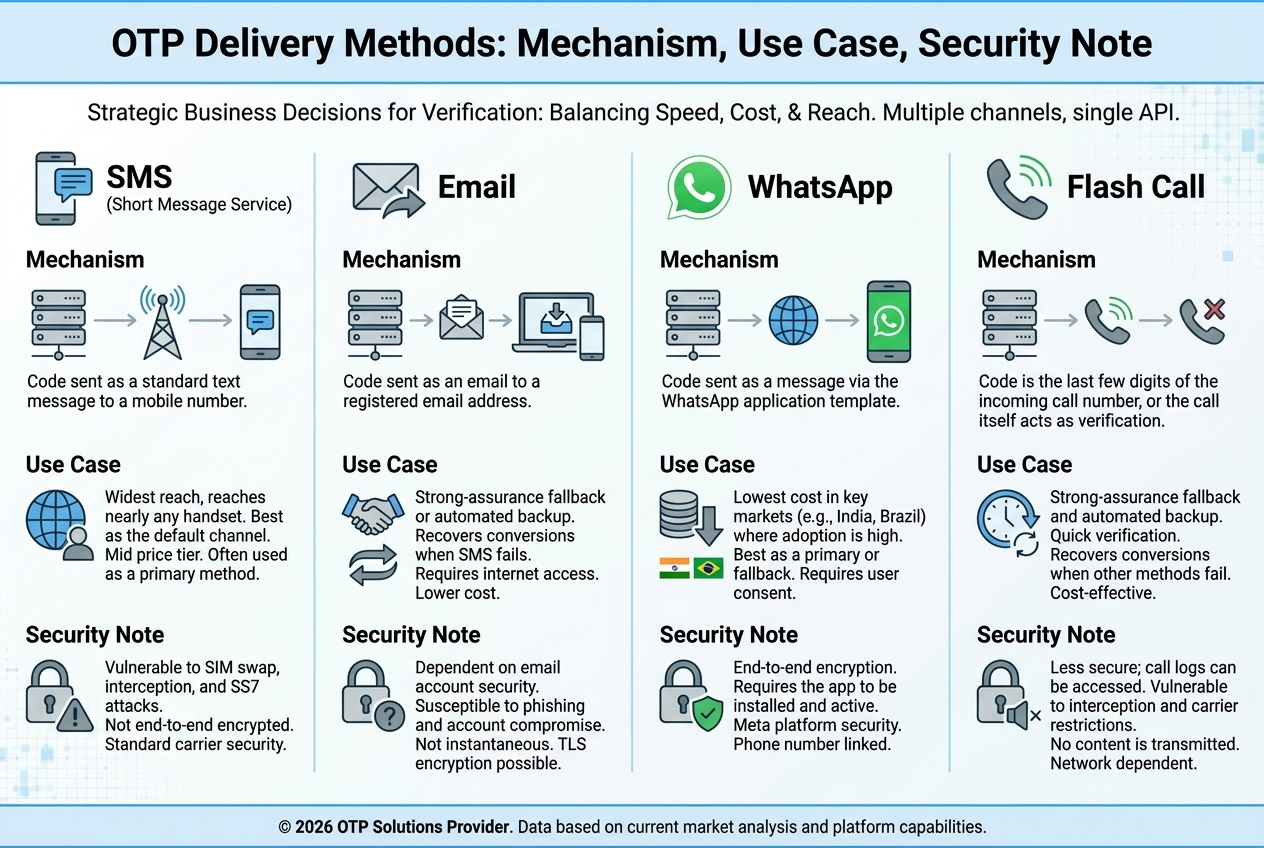
Channel choice is a strategic business decision, not a default, because each OTP delivery channel trades speed, cost, and reach differently. One retailer recovered failed SMS deliveries after adding a WhatsApp fallback behind SMS. SMS, WhatsApp, Voice, Viber, Telegram, and RCS are all recognized OTP delivery channels. An OTP service provider that supports multiple delivery methods routes them through one API.
Widest reach: SMS reaches nearly any handset at a mid price tier, best as the default channel.
Lowest cost in key markets: WhatsApp authentication templates undercut SMS in India and Brazil, best as a primary or fallback where adoption is high.
Strong-assurance fallbacks: Voice, Email, and Silent Network Authentication recover conversions when SMS fails, best as automated backups.
SMS OTP: still the universal default
SMS remains the dominant OTP channel despite a higher per-message price, because it needs no internet. Any phone with a SIM receives it, including feature phones. The mobile network operator provides the SMS infrastructure behind its broad global reach, though delivery can still fail on some routes. Most sms otp providers keep SMS as the baseline sms otp service for low-penetration markets.
WhatsApp OTP: the cost-effective alternative
WhatsApp authentication templates undercut SMS in specific markets, which makes the channel worth evaluating for any provider. Templates cost roughly $0.0014 each in India against $0.01 to $0.04 for SMS, and about $0.0068 in Brazil. The Meta WhatsApp Business Platform exposes authentication templates for OTP through its API. SMSFAST works as a multi-channel online OTP sender across SMS and messaging apps, which fits a business testing WhatsApp where adoption is high.
Voice, email, and silent network authentication as fallbacks
Fallback channels protect conversion when the primary code fails, making multi-channel fallback a revenue strategy. Voice OTP reads the code aloud, email OTP sends it to an inbox, and Silent Network Authentication confirms number ownership in the background. Silent Network Authentication verifies a number without user input, then falls back to SMS OTP when unavailable. An automated online OTP sender that handles this fallback logic separates an enterprise-grade OTP platform from a plain SMS gateway.
How OTP pricing really works, and where hidden costs hide
OTP pricing stacks in three layers that hide inside vendor quotes: a platform or verification fee, a channel or per-message fee, and carrier surcharges. Twilio Verify charges $0.05 per verification plus $0.0083 per US SMS. Carrier pass-through fees appear as a separate line and lift the effective cost above the quoted rate. A low-price claim, including jasa otp murah positioning, often hides the platform fee, which the mini-calc quantifies at about $500 per 10,000 codes.
The mini-calculation below compares per-verification and per-message models at 10,000 verifications per month, using published Twilio Verify rates.
Cost model
Rate
10,000 verifications per month
Per-verification plus US SMS
$0.05 + $0.0083
about $583
Channel-only, US SMS (zero-verification model)
$0.0083
about $83
Difference driven by platform fee
$0.05 per code
about $500
Additional hidden costs raise the total: A2P registration fees, multi-segment message surcharges, and losses from fraud and SMS pumping. Most OTP services operate as a SaaS on a usage-based model, so the API bill scales with volume, and a mobile network operator surcharge sits as its own layer. Regulatory compliance drives some items, because A2P registration is a compliance-driven cost, not optional.
Key criteria for choosing the right OTP service provider
Seven criteria decide the right vendor for a business, and each maps to a testable question. Compliance splits into requirement types that are not interchangeable: SOC 2 certifies a provider's data security, GDPR and CCPA regulate EU and California privacy, and HIPAA applies only when a provider handles protected health information. Identity verification service depth explains why fraud detection and fallback logic matter inside a wider security architecture.
Reliability and delivery rate: measure real delivery success per carrier in target markets, not a global average.
Global carrier coverage: confirm direct routes to the countries where your users actually verify.
Fraud detection and SMS pumping protection: require pre-send risk scoring and rate limiting, because SMS pumping inflates bills.
API and developer experience: judge the API by SDK quality, documentation, and time to first successful verification.
Pricing transparency: demand the platform fee, channel fee, and carrier surcharge as separate lines.
Multi-channel fallback: verify automated failover across SMS, Voice, and WhatsApp before you rely on it.
Compliance and security requirements: match SOC 2, GDPR, CCPA, and conditional HIPAA to your data obligations.
How the providers in this guide were evaluated
The following providers were selected from 25-plus vendors on OTP-specific capability, not general messaging reach. Because each OTP service provider offers an OTP verification service, scoring weighted fraud architecture, verification API depth, conversion analytics, fallback support, and compliance posture. Vendors without OTP-specific functions were excluded, and identity verification service strength carried extra weight, since each OTP service provider maintains regulatory compliance for its markets.
Fraud architecture: pre-send risk scoring, rate limiting, and SMS-pumping controls.
Verification API depth: dedicated verify endpoints, code lifecycle, and fallback control.
Conversion analytics: delivery receipts, verification status, and cost-per-verified-user reporting.
Compliance posture: SOC 2, GDPR, CCPA, and conditional HIPAA alignment.
Onboarding speed: time from signup to a first successful verification.
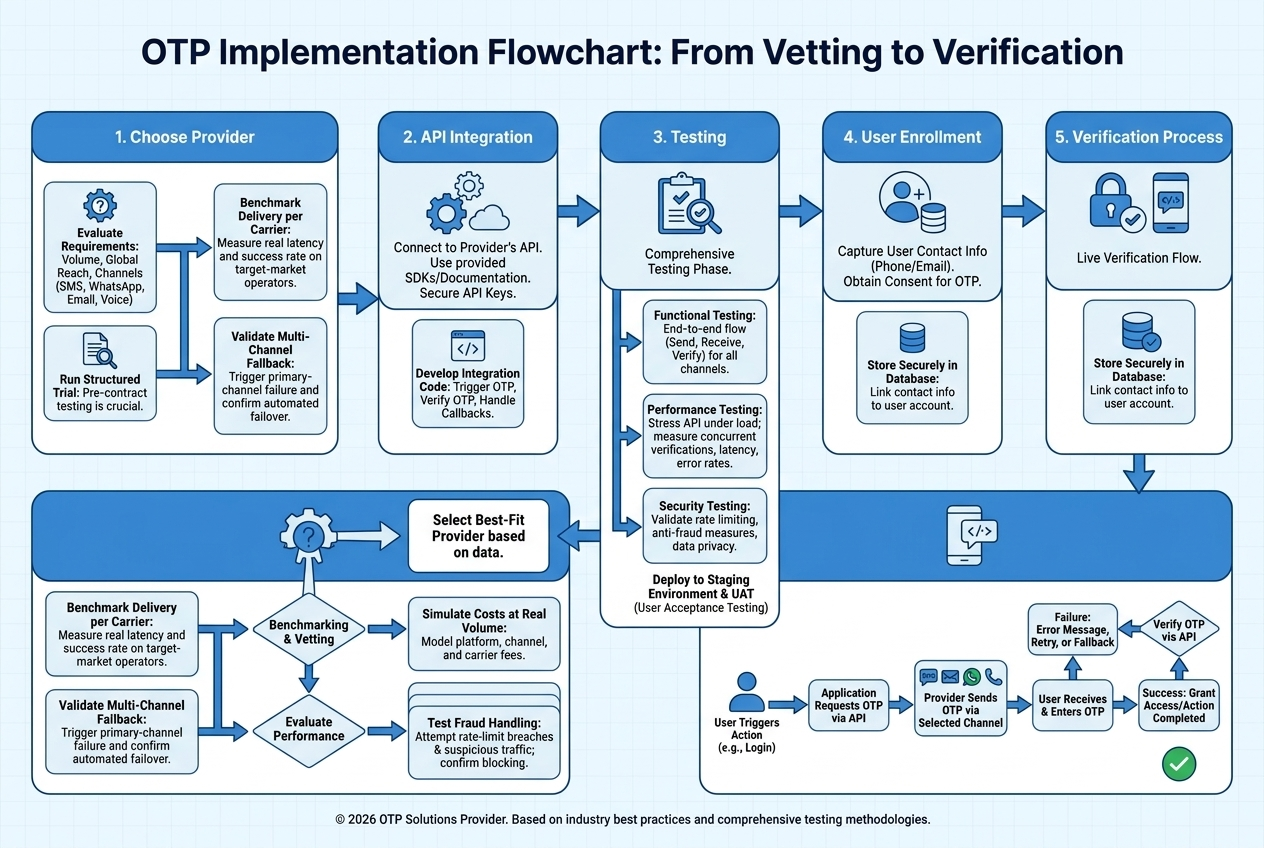
How to test and vet an OTP provider before signing a contract
Run a structured trial before any commercial commitment, because a demo hides the delivery gaps a real test exposes. During one trial, per-carrier benchmarking surfaced a delivery failure on a target route that would have broken production signups.
Benchmark delivery speed and success rate per carrier in target markets, not globally, because a mobile network operator route differs by country. Validate fallback channels by forcing an SMS failure and confirming Voice, WhatsApp, or email recovery. Test fraud scenarios by probing rate limiting and abuse-case behavior.
Benchmark delivery per carrier: measure real latency and success rate on each target-market operator.
Validate multi-channel fallback: trigger a primary-channel failure and confirm automated failover fires.
Stress the API under load: run concurrent verifications and watch latency and error rates.
Simulate costs at real volume: model platform, channel, and carrier fees against projected monthly verifications.
Test fraud handling: attempt rate-limit breaches and suspicious traffic, then confirm the vendor blocks them.
Final recommendation: choosing the best OTP provider for your business
The right OTP service provider is defined by verified volume, geographic reach, channel requirements, budget, and compliance obligations, not by a single label. Apply the seven criteria and the five-step testing framework from this guide before selecting a vendor. Twilio Verify suits channel breadth, Plivo Verify suits cost control, Infobip suits global scale, and Telesign suits fraud-sensitive platforms, while an international OTP service still needs per-market route testing.
SMSFAST is a practical option worth evaluating for businesses that want multi-channel verification across SMS and messaging apps. Match the vendor to your evidence, and the answer becomes context-specific rather than absolute.
Test your first verification with SMSFAST
Pick a service and country, buy a number, and receive the code in your dashboard in seconds
Frequently Asked Questions
What is an SMS OTP service, and how does it work?
An SMS OTP service sends a single-use, time-limited code by text to confirm a user owns a phone number. The provider generates the code, delivers it over an SMS gateway, and validates it on entry, typically within seconds. If no code arrives, most systems let the user retry or fall back to another channel.
What is the best OTP service provider for small businesses?
Plivo Verify fits many small businesses, because it charges $0.00 per verification and bills only for the channel used. Firebase Authentication suits mobile-first teams with free-tier sign-in methods. The right choice depends on volume, target countries, and whether fraud scoring is required.
How much does an OTP verification service typically cost?
OTP pricing usually stacks a per-verification platform fee, a per-message channel fee, and carrier surcharges. Twilio Verify charges $0.05 per verification plus $0.0083 per US SMS as a reference point. Hidden costs include A2P registration and multi-segment message surcharges, so compare total effective cost, not headline rate.
What is the difference between an OTP provider and a generic SMS gateway?
An OTP provider adds pre-send fraud scoring, multi-channel fallback, and conversion analytics, while a generic SMS gateway mainly transmits the message. A dedicated provider includes code generation, expiry, and retry logic that a raw API leaves to you. The vendor layers verification controls on top of delivery.
Can WhatsApp be used instead of SMS for OTP delivery?
Yes, WhatsApp authentication templates deliver OTP through the Meta WhatsApp Business Platform. WhatsApp costs roughly $0.0014 per message in India against $0.01 to $0.04 for SMS, a real saving where adoption is high. WhatsApp works best as a primary or fallback channel, not a universal replacement.
What security and compliance requirements should an OTP provider meet?
SOC 2 is a security framework, while GDPR and CCPA are privacy regulations for EU and California user data. HIPAA applies conditionally, only when a provider handles protected health information. Match each requirement type to your data obligations rather than treating them as one certification.
Why do users sometimes receive OTP messages they never requested?
Unrequested OTP messages arrive when an attacker enters someone else's number, a number is mistyped or reused, or a login flow is misconfigured. Rate limiting and pre-send risk scoring reduce this abuse. A user who receives an unexpected code should not share it and can ignore the message.
OTP bots are automated tools sold on Telegram for $10-$50 per session that intercept your 2FA codes in real time. Learn how they work, which industries they target, and how to stop them.
An SMS code is a short numeric one-time password sent by text to verify your identity. Learn how it works, where it's used, its security risks, and safer alternatives.